Word of mouth: why fans are your best salespeople
A recommendation from a fan is the warmest lead there is. How does word of mouth come about, why do you not need to beg for it, and how do you measure whether it is really happening?
- A recommendation from a fan is the warmest lead there is: the trust is already there before you speak to someone.
- Word of mouth happens after the signature, in small moments and above all in how you resolve a complaint.
- Measure what customers do, not what they promise: how many customers actually recommend you.
I once called recommendations "the tastiest leads of all". I still think so.
A lead that comes through a recommendation feels different. You call someone who already knows something about you. Someone who has already heard that you do what you promise. The first conversation does not start from zero.
What is word of mouth?
Word of mouth is when customers tell others about you and recommend you of their own accord. A colleague telling another colleague: you should call them. A business owner mentioning your name at a birthday party.
It is the most credible advertising there is. Because it comes from someone the other person already trusts.
Why are recommendations the warmest leads?
Think about how you choose yourself. Looking for a builder, an accountant or a trainer? You ask around first: who do you know?
Your customers work the same way. An advert says: we are good. A fan says: I have been through it, they are good. That is a big difference.
You notice it straight away in sales. With a cold lead, you spend the first part of the conversation building trust. With a recommendation, that trust is borrowed from the fan. You can get on sooner with what matters: listening and helping.
You buy advertising. You earn fans.
That line is from my new Dutch book Van klant naar fan (From customer to fan). It sums up why I wrote the book.
You can buy advertising. A campaign, ads, a smart website. Nothing wrong with that. But as soon as you stop paying, it stops.
You cannot buy fans. You earn them, customer by customer. And they keep talking about you, even when you are not in the room.
| Advertising | Word of mouth | |
|---|---|---|
| Who is talking? | You, about yourself | A fan, about you |
| How do you get it? | You buy it | You earn it |
| What if you stop? | It stops too | It carries on |
| How warm is the lead? | Cold to lukewarm | Warm: the trust is already there |
You need both. But if I had to choose where to put my best energy, I know my answer.
The numbers are clear. Nielsen researched worldwide which form of advertising people trust. At the top was not TV and not online ads, but recommendations from friends and family: 92 percent. McKinsey estimated that 20 to 50 percent of all purchasing decisions are driven by word of mouth. And researchers at Wharton showed that customers who come in through a recommendation are 18 percent less likely to leave.
So a recommendation does not just bring you a customer. It brings you a better customer.
How does word of mouth come about?
Not in the sales conversation. That is where you make a customer. You make a fan afterwards.
Word of mouth comes from the moments after the signature. Moments your customer does not expect. A few examples:
- You call after two weeks to ask how things are going, with nothing to sell.
- You send a tip or article that fits exactly what your customer is working on.
- You congratulate him on a milestone he once mentioned in passing.
- You introduce him to someone in your network who can help him further.
Small things. But these are the things people talk about. Nobody tells friends at a party that the invoice was correct.
A complaint is your biggest opportunity
In my view, the moment most fans are made is the moment something goes wrong.
That sounds odd. But think of your own experience. A company where everything always goes well, you think is fine. A company that made a mistake and resolved it quickly, honestly and with care, that is one you talk about.
A complaint shows who you really are. Do you duck, pass it on, or take the customer by the hand?
I recently spoke to the owner of Taartenwinkel.nl, a Dutch online cake shop. They bake their cakes themselves and the quality is excellent. Yet one weekend 0.4 percent of the cakes went wrong with the external delivery company. Four in a thousand. And anyone ordering a cake has a party that very day. So you still get that one review. He built a fixed protocol for it: spot earlier that something is going wrong, step in while you still can, and know what to do if it really fails. One way or another, that customer is now properly helped.
For the conversation itself I use the LEVER method from my first book, Sales, Honest & Relaxed. In Van klant naar fan I apply it to complaints:
- Listen. Let the customer finish completely, even if they are factually wrong.
- Empathise. Name how they feel. "I understand this is annoying for you."
- Verify. Ask questions. What exactly happened, and what bothers them most?
- Respond. Say what you will do, when, and what they can expect. Do not promise more than you can deliver.
And then the step that is not in the word: come back to it later. Ask whether it was resolved to their satisfaction. That call turns a resolved complaint into a fan.
Can you ask for a recommendation?
Yes. Many companies just do it the wrong way: with a discount attached, or three times by email. Begging will not turn a customer who is not a fan into one.
Mitchel Welling of WRA Juristen does it differently. He helps people who are facing dismissal. When a case is closed, he sends a gift box with a personal card. A week later he calls. Did the box arrive? Do you have any feedback for me? And only then: would you be willing to leave a short review? He now has well over a hundred Google reviews, with an average of 4.9.
Fans are happy to give something back. They just do not know how. Ask at the moment they are happiest, and make it concrete. So not "would you recommend us?", because everyone politely says yes to that. Instead: "Who would you recommend us to?"
Want to know what such a fan actually does? Read what a customer ambassador is.
How do you measure whether it is really happening?
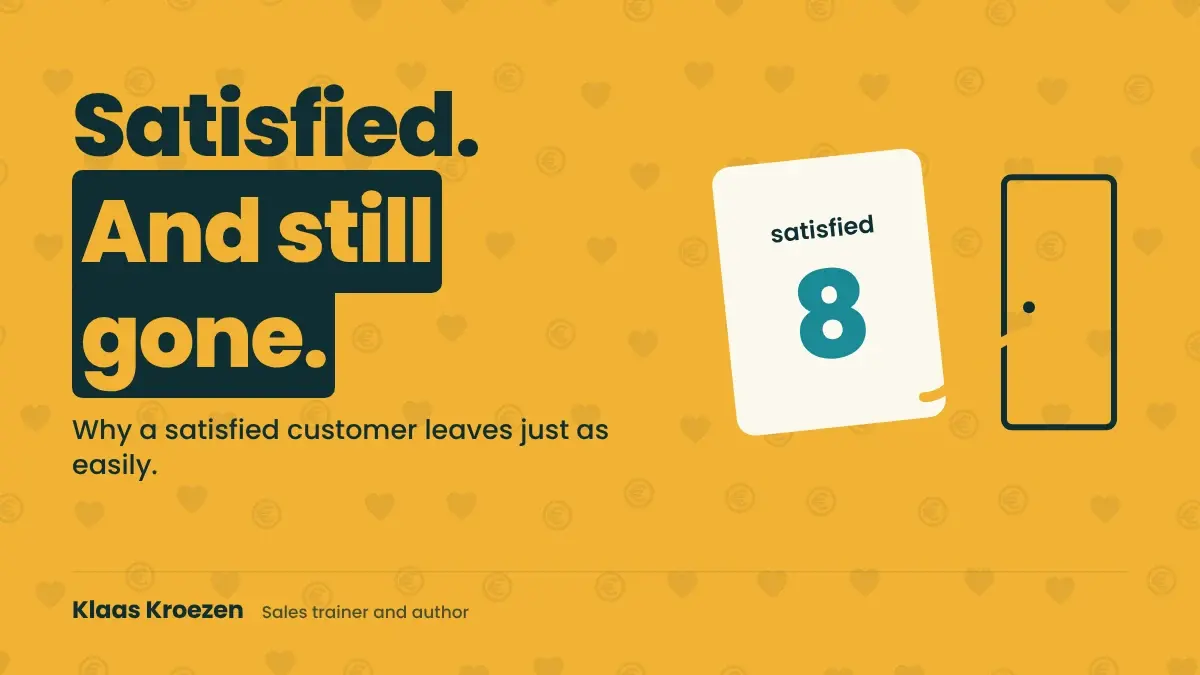
This is where it often goes wrong. Many companies measure NPS: how likely are you to recommend us? A good question. But it is a promise. Someone says they would recommend you. Whether they actually do, you do not know. More on that in why an 8 is not a fan.
That is why I built the Fanscore. Your customer scores nine statements. The NPS question is in there, plus one yes/no question: "I have recommended them in the past six months." Someone who says they would recommend you but never has is not a fan yet. That gives you an honest picture of your word of mouth. And you can see whether it is improving.
Want to know where your own team stands on customer experience? The free Customer Experience Model scan helps. The same scan, with 46 statements, is in the back of the book.
You can read more about the book in my announcement of Van klant naar fan. It comes out on 14 November 2026, in Dutch, and you can pre-order it now as a hardback, e-book and audiobook, read by me.
My question for you: when did a customer last recommend you of their own accord? And what had you done to earn it?
You buy advertising. You earn fans.
Frequently asked questions
What is word of mouth?
Word of mouth is when customers tell others about you and recommend you of their own accord. It is the most credible form of advertising, because it comes from someone the other person already trusts.
Why are recommendations such good leads?
Because the trust is already there. According to Nielsen, 92 percent of people trust recommendations from friends and family, more than any form of advertising. And researchers at Wharton found that customers who come through a recommendation are 18 percent less likely to leave.
How do you get more word of mouth?
By turning customers into fans. That mostly happens after the sale: in the aftercare, in unexpected attention and in how you resolve a complaint. Fans pass it on of their own accord.
How do you measure word of mouth?
Look at behaviour instead of promises. An NPS question measures whether someone says they would recommend you. The Fanscore asks nine statements, including whether the customer has actually recommended you in the past six months.
Read also

Klaas Kroezen is an entrepreneur who trains, coaches and speaks. He wrote the #1 Dutch bestseller Sales, Honest & Relaxed and the new book Van klant naar fan (From customer to fan, November 2026). After 25+ years in sales with his own international market research firm, he helps organisations adopt the From customer to fan mindset: selling honestly and relaxed, and turning customers into fans with the whole team.
More about Klaas