What is a customer ambassador, and how do you turn customers into ambassadors?
A customer ambassador is a fan who actively recommends you. How is that different from a satisfied customer, why can you not buy ambassadors, and how do you create them with your whole team?
- A customer ambassador is a fan who recommends you to others of his own accord.
- You do not buy ambassadors with discounts or rewards. You earn them through how your customer feels at every contact.
- Do not measure what customers promise, measure what they do: how many customers really recommend you.
Every business owner knows that phone call. "I am calling because a friend told me you are good."
That conversation is different from all the others. The trust is already there before you have said a word. Someone else has done the work for you.
That someone is a customer ambassador.
A customer ambassador is a customer who is so happy with you that he recommends you to others of his own accord. He is a fan who actively spreads the word.
What is the difference between a satisfied customer, a fan and an ambassador?
People often mix these three up. Yet they are different.
| What he gives you | What he does | |
|---|---|---|
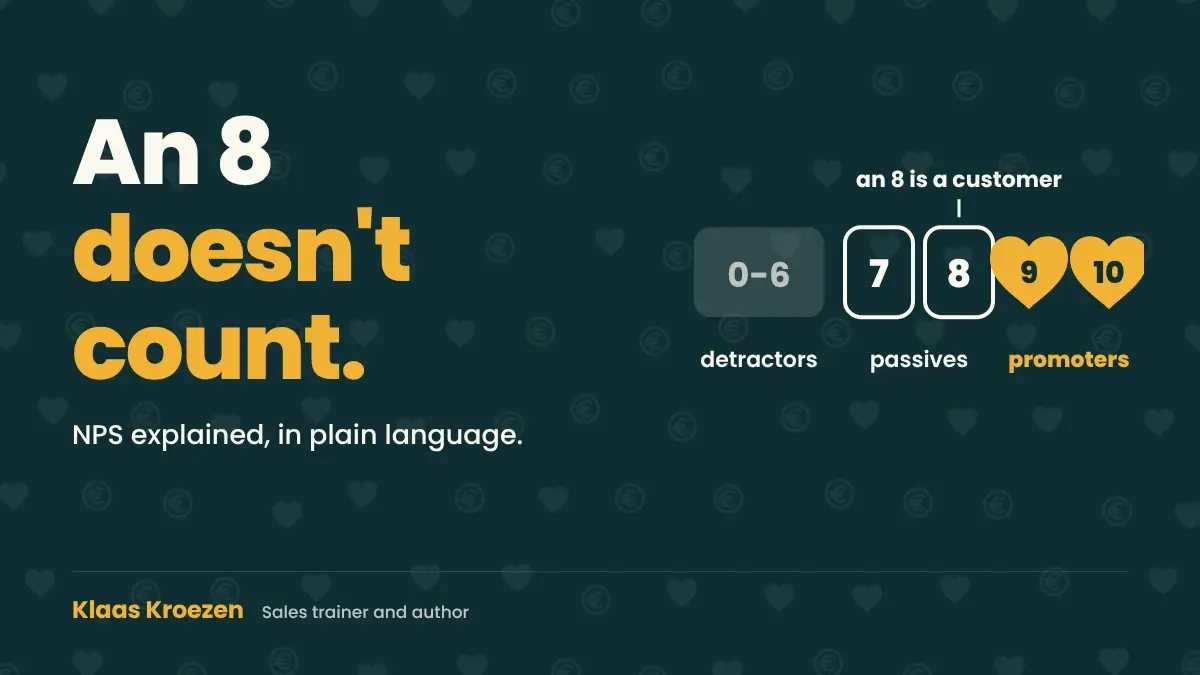
| Satisfied customer | A 7 or 8 | Pays, does not complain, will just as easily choose someone else |
| Fan | A 9 or 10 | Is happy to come back and buys more |
| Ambassador | A 9 or 10 | Does everything a fan does, and actively tells others |
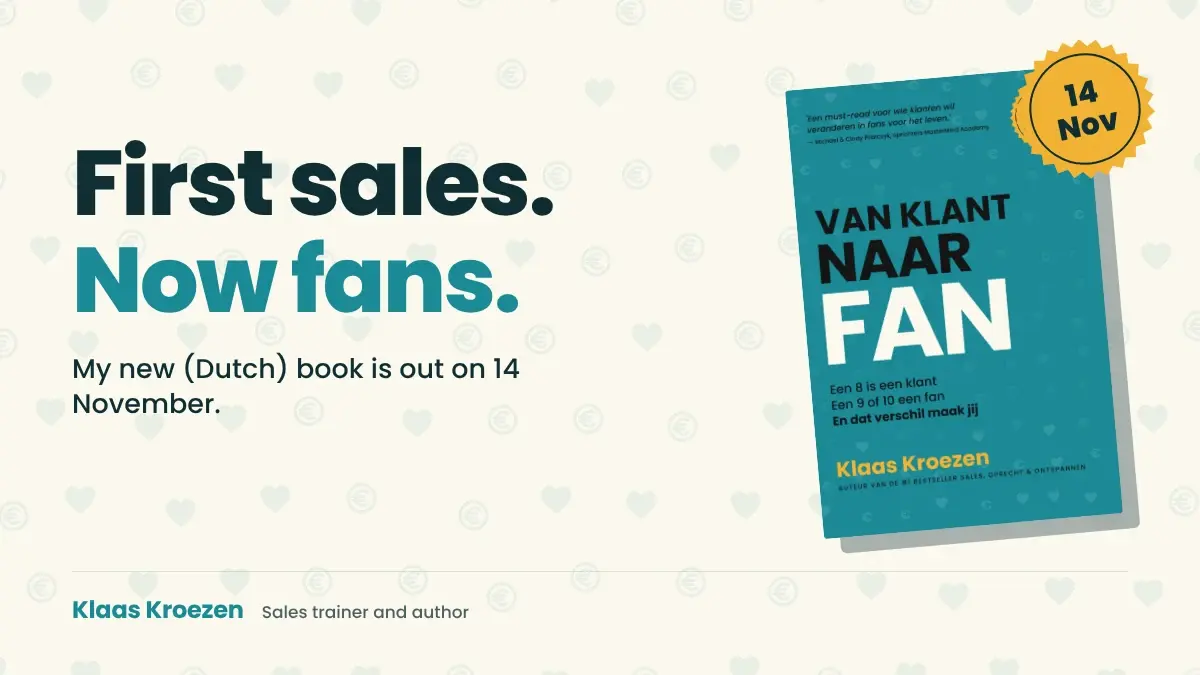
In my new book, the Dutch book Van klant naar fan (From customer to fan), I put it like this: an 8 is a customer. A 9 or 10 is a fan. And you make that difference.
An ambassador is the next step. Every ambassador is a fan. But not every fan tells others. Some fans are loyal and quiet. An ambassador mentions your name when someone asks: "Do you know anyone who...?"
Why are customer ambassadors so valuable?
Because people believe each other more than they believe your website.
When you say you are good, that is advertising. When a customer says it, that is proof. That is why customers who come in through word of mouth are often half convinced already.
The customers ambassadors bring you are worth more too. Researchers at Wharton showed that customers who come in through a recommendation are 18 percent less likely to leave than customers who come through advertising. Retention and ambassadors go hand in hand.
Dutch insurer Nh1816 shows how far this can go. They work only through local, independent advisers, and they turn those advisers into fans. The management visits them, calls when something is up, and calls again the next day to hear how it went. On the recommendation question they score 92, while the average in their sector is 32. Their number of policies grew from one million in 2013 to three million.
Can you buy ambassadors?
No.
I see it often. A company wants more referrals and comes up with a campaign. "Bring a friend and get 10% off." A few names come in. And then it stops.
That is because you are buying behaviour, not a feeling. Someone who recommends you for a discount tells the story with half a smile. Someone who recommends you because you really helped him tells it with conviction.
In the book I write: advertising you buy, fans you earn.
A thank you is always fine. A card or some flowers for someone who referred a friend is a lovely gesture. But that is a consequence. The cause lies in what the customer experienced with you.
How do you turn customers into ambassadors?
There is no trick. There are a few things you can do tomorrow.
1. Start with yourself
The fan mindset starts with you. Your energy shapes how your customer feels. On a difficult day too, and with the fifth customer who calls with the same question.
After every customer conversation, ask yourself: would this customer give me a 9? Why, or why not?
2. Make sure the whole team takes part
Your customer does not see departments. He sees one company. Your salesperson can be brilliant, but if the invoice is wrong or the helpdesk never calls back, it will not be a 9.
You create fans together. Everyone shapes what the customer experiences, including the people behind the scenes. That is why customer focus is never the job of one department. You can read more in what customer focus really means.
3. Build trust and guide your customer by the hand
For fifteen years my research agency watched hundreds of thousands of customers go through a real customer journey. Two things weighed most every time: trust, and the feeling of being taken by the hand. Say what you will do, then do it. Never leave your customer searching for the next step.
4. Turn a complaint into an opportunity
A customer with a complaint stands at a crossroads. Handle it badly and he will tell others, just not in a good way. Handle it well and he often becomes a fan.
I use the LEVER method from my first book, Sales, Honest & Relaxed:
- Listen: let the customer finish completely.
- Empathise: name how they feel, without defending yourself.
- Verify: ask what exactly happened and what bothers them most.
- Respond: say what you will do, when, and what they can expect.
And come back to it later. Call and ask whether it was resolved to their satisfaction. Hardly anyone expects that call, and that is exactly what they remember.
5. Simply ask
Many happy customers would gladly recommend you. They just do not think of it.
After a good project you can simply ask: "Who would you recommend us to?" Notice the word "who". To "would you recommend us?" everyone politely says yes. "Who to?" makes it concrete. No pressure. No reward. Just an honest question to someone who is happy with you.
How do you measure whether you are gaining ambassadors?
Many companies measure customer satisfaction with a score or with NPS. That is a good start. But that question measures a promise: how likely is it that you would recommend us?
You recognise an ambassador by what he does. That is why I built the Fanscore. Your customer scores nine statements. The NPS question is in there, plus one yes/no question: "I have recommended them in the past six months." Behaviour, not a promise.
That way you can see whether your team's work really creates more ambassadors. And where there is still room to grow.
Want to know how you and your team score on customer experience? Read about the Customer Experience Model. And in my new book I work this out chapter by chapter.
My question for you: which customer recommended you in the past year? Call him this week, thank him, and ask what made him mention your name.
Advertising you buy. Fans you earn.
Frequently asked questions
What is a customer ambassador?
A customer ambassador is a customer who is so happy with you that he recommends you to others of his own accord. He is a fan who actively spreads the word.
What is the difference between a satisfied customer and an ambassador?
A satisfied customer gives you a 7 or 8 and will just as easily choose someone else. An ambassador gives a 9 or 10, comes back and tells others about you.
Can you reward ambassadors with a discount or a gift?
A thank you is always fine. But a reward does not turn anyone into an ambassador. People recommend you because they had a good experience, not because they get something for it.
How do you measure how many ambassadors you have?
With the Fanscore. Your customer scores nine statements, including whether they have actually recommended you in the past six months. That is behaviour, not a promise, so you can see whether your number of ambassadors is growing.
Read also

Klaas Kroezen is an entrepreneur who trains, coaches and speaks. He wrote the #1 Dutch bestseller Sales, Honest & Relaxed and the new book Van klant naar fan (From customer to fan, November 2026). After 25+ years in sales with his own international market research firm, he helps organisations adopt the From customer to fan mindset: selling honestly and relaxed, and turning customers into fans with the whole team.
More about Klaas