The Customer Experience Model: the six elements that turn customers into fans
The Customer Experience Model shows in six elements what turns a customer into a fan: two core attitudes and four skills. With a free scan.
- The Customer Experience Model describes in six elements what turns a customer into a fan: two core attitudes and four skills.
- The core attitudes are honest and relaxed; the skills are beliefs, content, process and form. Those four can be trained.
- With the free scan of 46 statements you see where you or your team stand and where the biggest gains are.
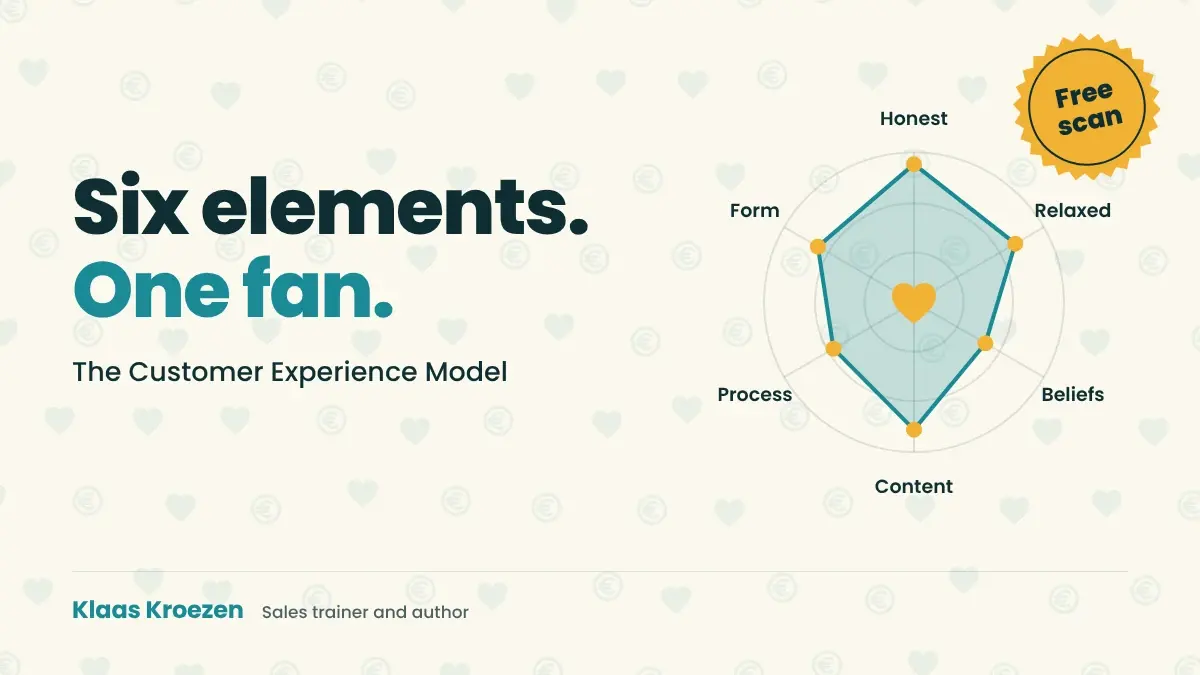
The Customer Experience Model is a measuring stick with six elements that decide whether someone stays your customer or becomes a fan. Two of them are core attitudes: honest and relaxed. Four are skills you can train: beliefs, content, process and form. The outcome of the model is the fan.
Why do you need a measuring stick? Because customer contact often feels hard to pin down. One month it flows, the next it stalls, and you do not really know why. With a measuring stick you can suddenly put a name to it.
Why a model about customers and fans?
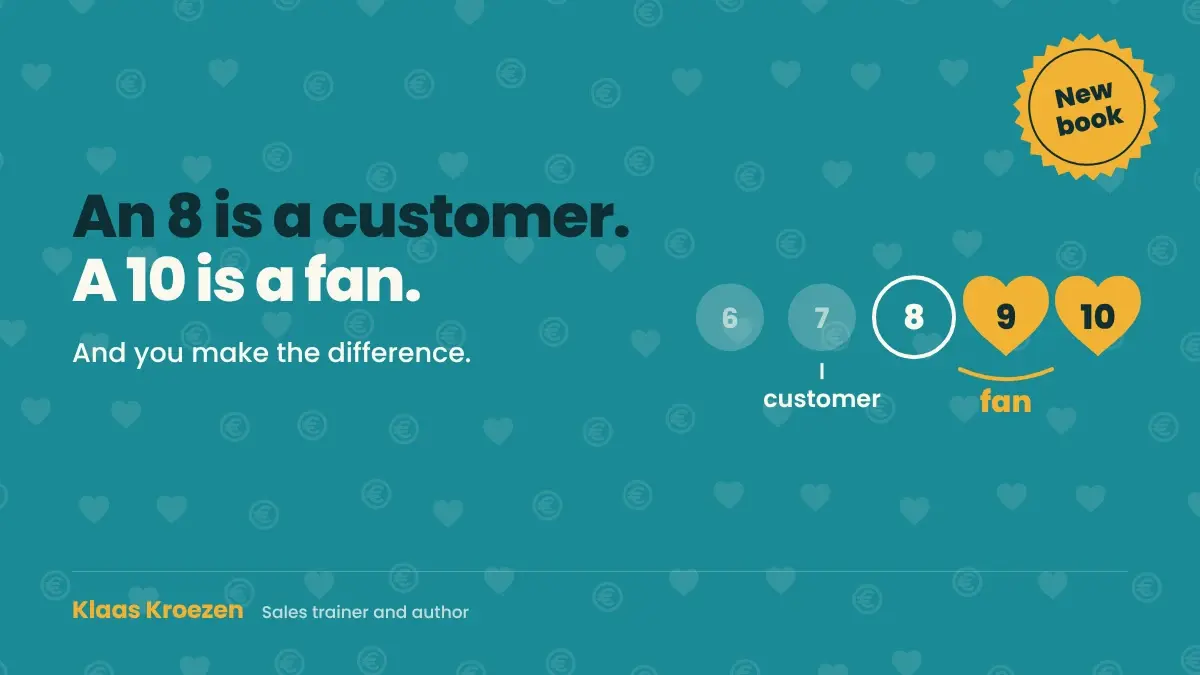
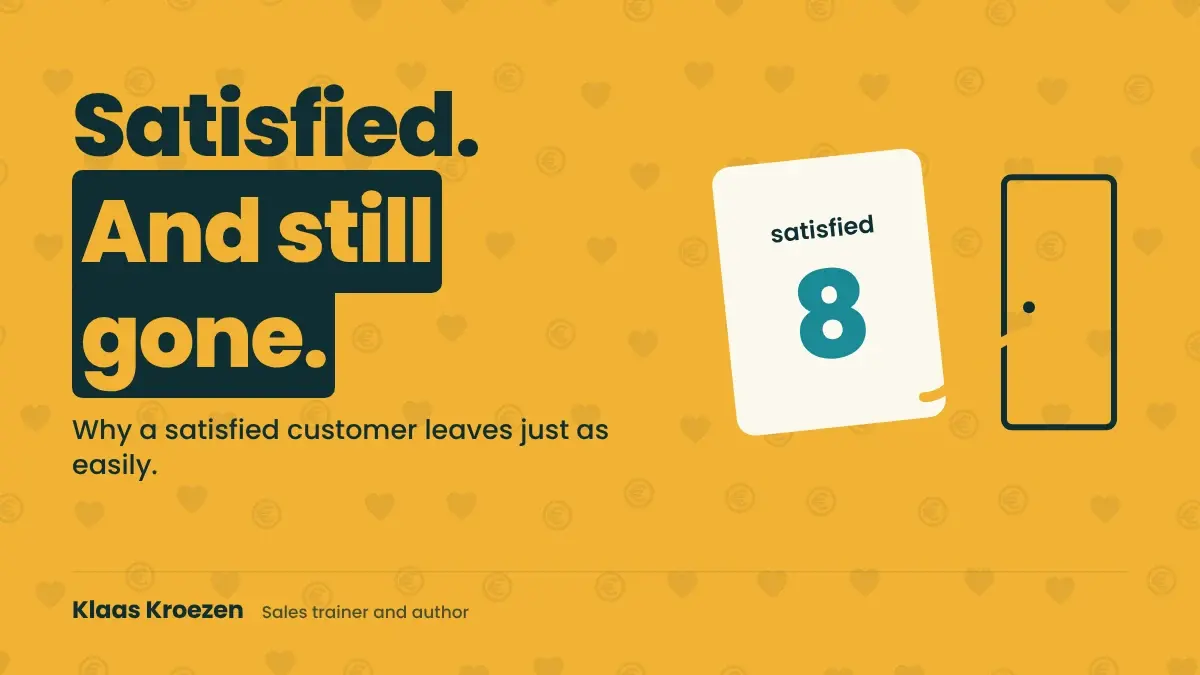
An 8 is a customer. A 9 or 10 is a fan. That difference is big, because a fan comes back, buys more and tells others about you. But what exactly sits between that 8 and that 9?
I asked myself that question after a painful phone call in 2014. A large customer, one I had worked on for four years, stopped. Not because of the sale, but because of the delivery. I had never built a system that showed my whole team what turns a customer into a fan. When I looked at how the biggest organisations do it, I saw that they all use a model: a shared language for talking about customers.
The statements in my model come from two sources. From the research on fans and customer focus. And from fifteen years of customer research with my agency, in which we watched hundreds of thousands of customers go through a real customer journey. Two things weighed most every time: trust, and the feeling of being taken by the hand. It kept coming down to the same six elements.
The model at a glance
| Element | Type | The question you ask yourself |
|---|---|---|
| Honest | Core attitude | Do I really care about this customer? |
| Relaxed | Core attitude | Can I let go of the pressure, so the customer relaxes too? |
| Beliefs | Skill | What do I believe about selling and about customers? |
| Content | Skill | Do I understand the real problem, and can I explain it clearly? |
| Process | Skill | Does my customer always know what the next step is? |
| Form | Skill | How do I come across, at first contact and afterwards? |
The two core attitudes
The core attitudes shape everything that follows. Without these two, the best techniques will not help you.
Honest means you genuinely care about the customer. You want to solve their problem, even if that means they buy less from you. Customers feel your intention before they hear your words. The first statement in the model is: "I come to bring value, not to take it." I say it to myself before every conversation. Make helping your goal, and you naturally ask the right questions.
Relaxed means you let go of the pressure to perform. That sounds soft, but it actually takes nerve. When you are relaxed, your customer relaxes too. There is room for a real conversation, and in a real conversation you hear what someone needs.
The four skills
The other four you can learn and practise. That is why they are also the basis of my training programmes.
Beliefs are your inner compass. If deep down you think selling is a bit grubby, you radiate it. Customers notice. Turn that belief around: selling is helping someone make a good choice.
Content is about becoming the trusted adviser. You know your field, you understand your customer's real problem and you can explain it in plain language. That builds trust.
Process is your customer's journey, from first contact to well after the purchase. A good process takes your customer by the hand. They never have to guess what happens next or whom to call.
Form is how you come across. Your first impression, your story, your calm. Your emails and your proposal count too.
Why it is about more than sales
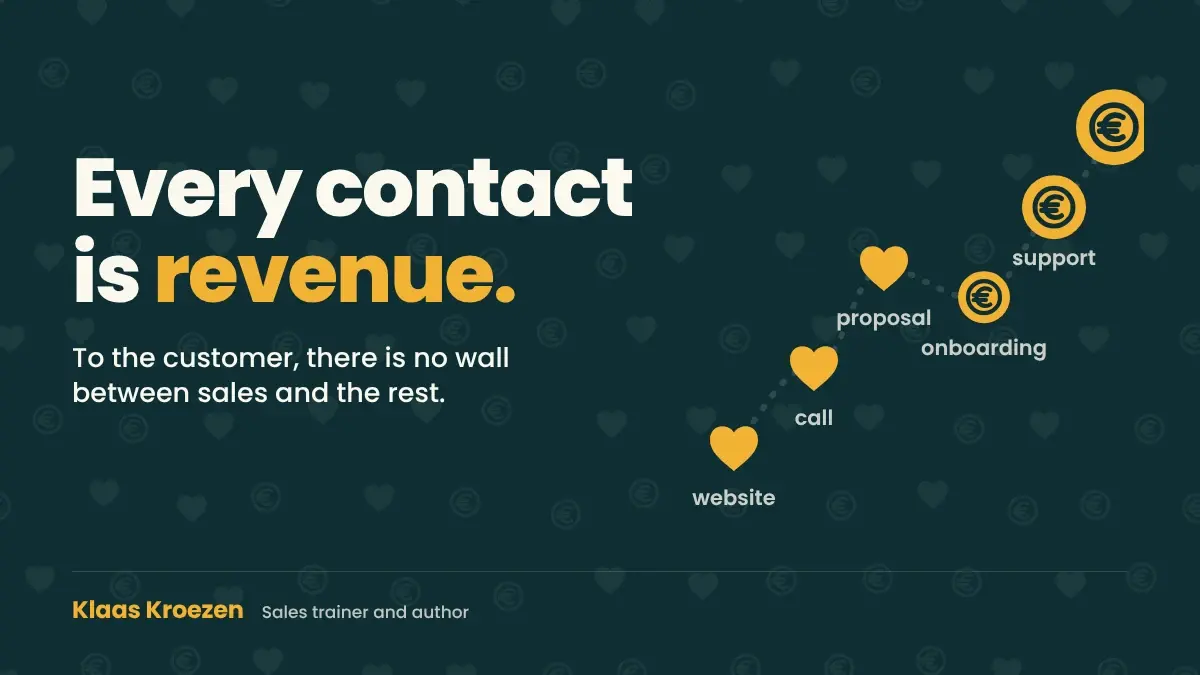
When I developed the model, I mainly had salespeople in mind. I know better now. Your customer does not see departments, they see one company. The support colleague, the project lead and the person who sends the invoice all help decide whether someone gives an 8 or a 9.
That is why the model works for everyone with customer contact. A support team can score high on honest and low on process. A sales team can be strong on form and still be tense. You only see differences like that when you measure.
Does it work in practice?
Joost wanted to do things differently. We measured where he stood with the Customer Experience Model, and again a month later. The result? 21.7% better at sales. In just one month. You can read Joost's story here.
My biggest insight: you do not have to improve everything at once. Start with the element where you score lowest. That is where the biggest gains are.
How do you measure it?
You measure the model with 46 statements. For each statement you indicate how strongly it applies to you. That gives you a score per element, so you see in one picture where you stand.
You can do this in two ways:
- Online. The free scan takes a few minutes. You see your scores on the six elements straight away.
- With your team. Have everyone fill in the scan and put the results side by side. Talk about where you differ most.
And what does your customer think?
With the scan you score your own behaviour. But what does that deliver for the customer? That is why I developed the Fanscore. Your customer scores nine statements, such as "I trust them completely" and "They help me move forward". One of them is a simple yes or no: "I have recommended them in the past six months." Put your own score next to your customers' scores and you see where the gap is.
What do you do with your result?
A score is only worth something if you act on it. Here are examples of a first step for each element:
- Low on honest? Before every customer conversation, ask yourself: what does this customer gain from it, even if they buy nothing?
- Low on relaxed? Stop scheduling conversations back to back. Take five minutes to arrive calmly.
- Low on beliefs? Write down what you think about selling. Does that still fit how you want to help customers?
- Low on content? Explain your offer to someone outside your field. If they do not get it, your customer probably does not either.
- Low on process? Write down the steps after the purchase. Where does your customer hear nothing from you for a while?
- Low on form? Read your last three emails to customers out loud. Would you enjoy receiving them?
The full scan is also at the back of my new Dutch book Van klant naar fan (From customer to fan), so you can keep scoring yourself and your team. If you first want to know more about honest and relaxed selling itself, read Sales, Honest & Relaxed.
Take the scan this week, pick your lowest element, and decide on one thing you will do differently there tomorrow.
Customers feel your intention before they hear your words.
Frequently asked questions
What is the Customer Experience Model?
The Customer Experience Model by Klaas Kroezen describes six elements that decide whether someone stays a customer or becomes a fan: two core attitudes (honest and relaxed) and four skills (beliefs, content, process and form). The outcome of the model is the fan.
How do you measure the Customer Experience Model?
With a scan of 46 statements on which you score yourself or your team. The free online version is at klaaskroezen.nl/customer-experience-model and gives you a score for each element.
Where can I find the complete model?
The complete model, as a scan with 46 statements, is at the back of the new Dutch book Van klant naar fan (From customer to fan), out on 14 November 2026. The thinking behind honest and relaxed selling is in Sales, Honest & Relaxed.
Who is the model for?
For anyone with customer contact: business owners, salespeople, customer success, support and their managers. The model is about the whole customer experience, so not only about sales.
How do I use the model with my team?
Have everyone fill in the scan and compare the scores. Then pick the one element where the team scores lowest and work on it in a focused way for a few weeks.
Read also

Klaas Kroezen is an entrepreneur who trains, coaches and speaks. He wrote the #1 Dutch bestseller Sales, Honest & Relaxed and the new book Van klant naar fan (From customer to fan, November 2026). After 25+ years in sales with his own international market research firm, he helps organisations adopt the From customer to fan mindset: selling honestly and relaxed, and turning customers into fans with the whole team.
More about Klaas