From customer to fan: what is a fan and how do you create one?
A satisfied customer is not yet a fan. An 8 is a customer, a 9 or 10 is a fan. Read what a fan is, why fans drive customer retention and how to create them.
- A fan is a customer who gladly comes back, buys more and tells others about you without being asked. An 8 is a customer, a 9 or 10 is a fan.
- Fans are made through trust and by taking customers by the hand, especially when something goes wrong.
- Your customer does not see departments but one company: everyone in your team helps decide whether someone becomes a fan.
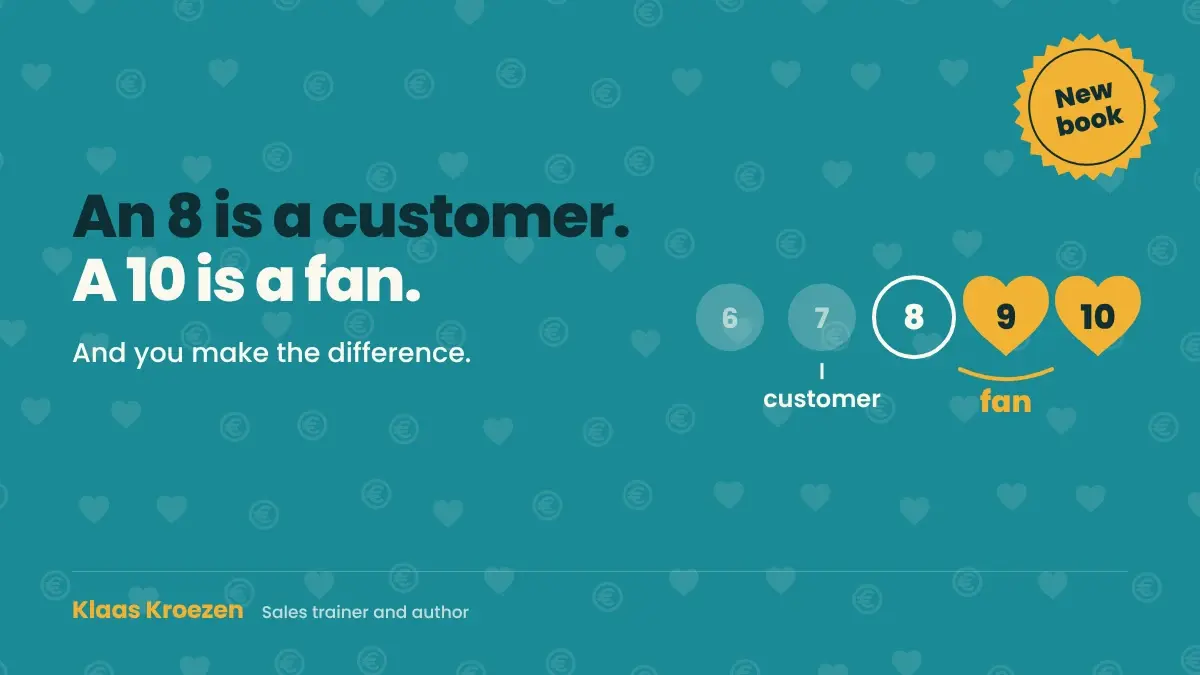
A fan is a customer who gladly comes back, buys more from you and tells other people about you without being asked. A satisfied customer does not do that. They are reasonably happy, pay their invoice and are gone as soon as something better comes along.
My shortest version: an 8 is a customer. A 9 or 10 is a fan. And you make that difference.
Why is an 8 not good enough?
Ask a customer for a score out of ten and you will often get a 7 or an 8. That feels fine. At school an 8 was a good mark.
But look at what an 8 actually does. They do not complain. They do not recommend you either. When a competitor rings with a sharper offer, they simply listen. Nothing is wrong, but nothing is keeping them with you.
A customer who gives you a 9 or 10 behaves differently. They call you first. They tell a colleague: "That is where you need to go." They forgive you a small mistake, because they know you will sort it out.
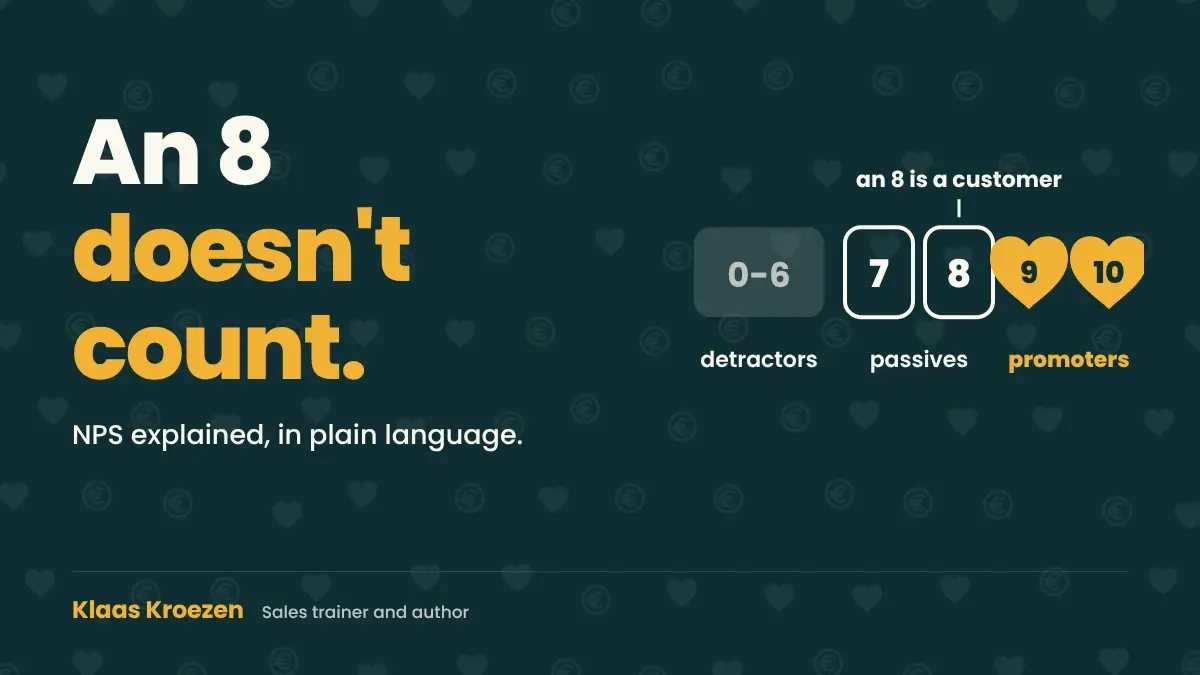
This is also why the Net Promoter Score (NPS) does not count a 7 or an 8 as a promoter. I wrote a separate piece about that: NPS: why an 8 is not a fan.
What is a fan worth?
In the early nineties Xerox asked customers on a large scale how satisfied they were, on a scale of 1 to 5. Then they looked at what those customers did next. The customers who gave a 5 bought again six times as often as the customers who gave a 4. A 4 out of 5 is an 8 out of 10. Six times as often, just from that last little step.
A fan stays longer, buys more and does your marketing for free. Word of mouth is still the strongest thing there is. In the book I put it like this: advertising you buy, fans you earn.
So a fan is no side issue. A fan is the best reason to take your customer experience seriously.
How do you turn a customer into a fan?
With my research agency WUA we spent fifteen years watching hundreds of thousands of customers go through a real customer journey. Choosing a mobile phone with a contract. Making a claim with a health insurer. When we calculated what weighed most, the same two things came out on top every time. Trust. And the feeling of being taken by the hand.
Trust starts in the very first conversation. Are you really listening, or waiting for your turn to pitch? Customers feel that straight away.
When I was looking for a large screen for my training sessions, I called two suppliers. The first rattled off specifications for five minutes. The second, Marcel, asked two questions: what do you want to use it for, and roughly what is your budget? Then he listened. I bought the screen from Marcel, and I am still a fan.
If you are genuinely curious, you ask better questions without trying. That is how business owner Max de Weijer went from 1 or 2 customers per 10 leads to 7 or 8. He stopped pushing and started showing real interest.
Taking someone by the hand means your customer never has to guess what happens next. They know the next step, who to call and when they will hear from you. That gives peace of mind. And peace of mind is where trust grows.
What do you do when something goes wrong?
This is the moment most people underestimate. Something goes wrong: a late delivery, a wrong invoice, a promise that is not kept.
Many companies get defensive. They explain why it was not their fault. What the customer mostly hears is: you are being difficult.
This is exactly where you can make the difference. A customer whose problem you solve quickly and with empathy often becomes a bigger fan than one who never had a problem. Because now they know how you behave when it matters.
I use the LEVER method from my first book for this. Listen: let the customer finish. Empathise: name how they feel. Verify: ask what is really bothering them. Respond: say what you will do and when. And then come back to it later to ask whether it was resolved to their satisfaction.
Who creates the fans in your company?
Your customer does not see departments. They see one company.
They do not know that sales and support sit on different floors. They only know they had a lovely conversation with the salesperson and then waited three days for an answer. It all adds up to one score.
So everyone shapes what the customer experiences. The owner who sets the tone. The manager who gives people room to really help a customer. The colleague on the phone. And the people who never speak to a customer, but who send the invoice or pack the parcel.
That is also why customer focus is never one department. It is how you work together.
What can you do tomorrow?
You do not need to wait for a big project. Here are three things I do myself and teach teams:
- Call a customer who gave you a 7 or 8. Ask: "What would have had to happen to make it a 10?" Listen, and write it down.
- Walk through your customer's journey. What happens in the first week after the purchase? Who takes them by the hand then? There is often a gap.
- Treat the next complaint as a chance. Respond quickly, acknowledge what went wrong and fix it. Then call once more to check everything is all right.
Want to know where you stand? The Customer Experience Model shows which attitudes and skills make the difference between an 8 and a 9. You can score yourself and your team with the free scan.
Why I wrote a book about this
My first book, Sales, Honest & Relaxed, was about selling. But selling is only half the story. What happens after the sale decides whether your customer stays and brings others along. That is the subject of my new book, the Dutch Van klant naar fan (From customer to fan), out on 14 November 2026. Every chapter opens with a story and ends with something you can do the next day.
My question to you: which customer last gave you an 8, and what will you do this week to make it a 9?
An 8 is a customer. A 9 or 10 is a fan. And you make that difference.
Frequently asked questions
What is the difference between a satisfied customer and a fan?
A satisfied customer is reasonably happy and gives you a 7 or 8. A fan gives you a 9 or 10: they gladly come back, buy more and recommend you to others of their own accord.
How do you turn a customer into a fan?
By building trust and taking your customer by the hand, from the first conversation to well after the purchase. In fifteen years of customer research covering hundreds of thousands of customer journeys, those two factors carried the most weight every time.
Why is a fan worth more than a satisfied customer?
A fan stays longer, buys more and creates word of mouth. In the early nineties Xerox found that customers who scored them 5 out of 5 bought again six times as often as customers who gave a 4.
Who in a company creates fans?
Everyone. The customer sees one company, so the owner, the manager, the people who speak to customers and the people behind the scenes all shape what the customer experiences.
Read also



Klaas Kroezen is an entrepreneur who trains, coaches and speaks. He wrote the #1 Dutch bestseller Sales, Honest & Relaxed and the new book Van klant naar fan (From customer to fan, November 2026). After 25+ years in sales with his own international market research firm, he helps organisations adopt the From customer to fan mindset: selling honestly and relaxed, and turning customers into fans with the whole team.
More about Klaas