Customer experience is sales: why every customer experience is revenue
Improving customer experience brings in revenue, because every customer experience is selling. Read why the wall between sales and the rest costs you money.
- Customer experience is sales: every contact a customer has with your company helps decide whether they stay, buy more and recommend you.
- The customer does not see departments. The wall between sales and the rest only exists inside your own company, and it costs you revenue.
- That is why customer focus applies to everyone with customer contact, from support to the finance team.
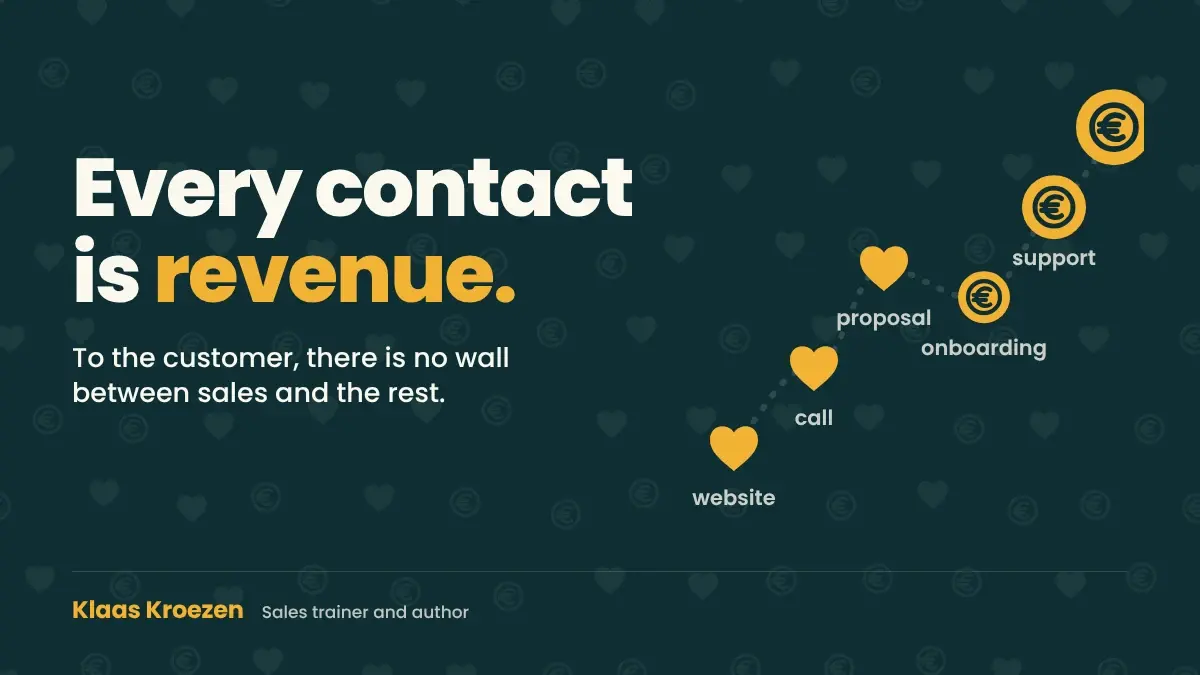
Customer experience is sales. By that I mean: every contact a customer has with your company helps decide whether they stay, buy more and recommend you. So every contact is selling, even when there is no salesperson in the room.
Many companies see it differently. They have a wall.
The wall between sales and the rest
On one side sits sales. They bring in new customers. On the other side sits everyone else: support, delivery, project management, finance. They serve the customer afterwards. Two worlds, two goals, often two floors.
That wall costs you money.
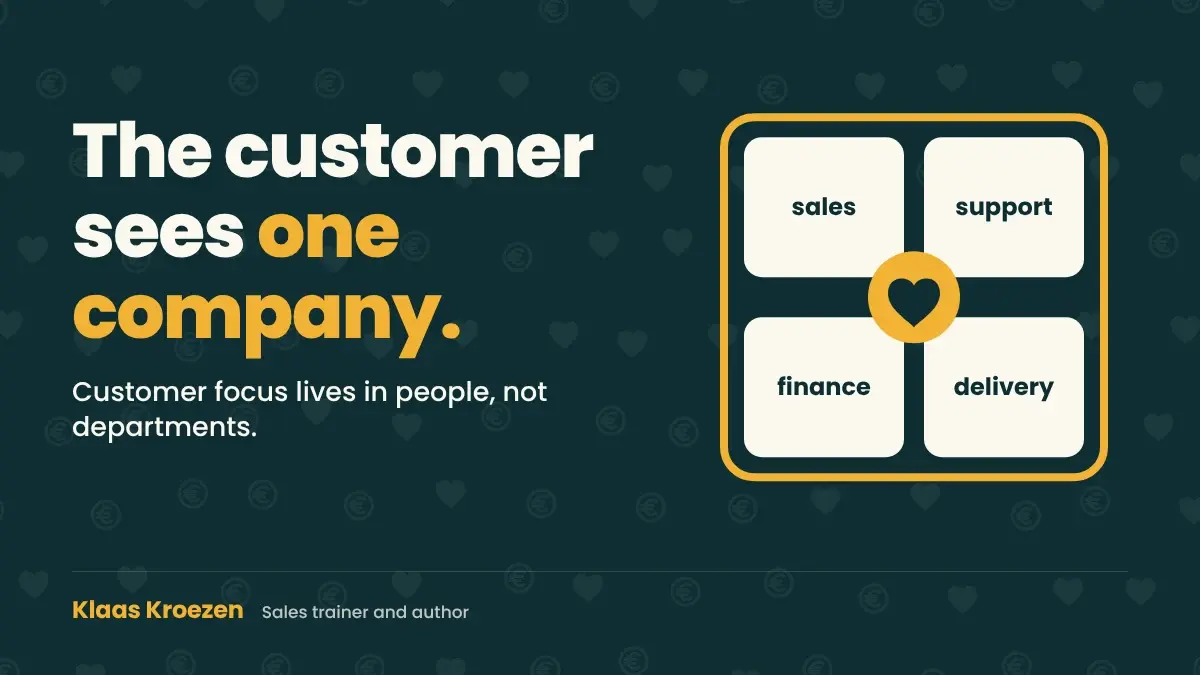
Because your customer does not see departments. They see one company. The email that goes unanswered, the promise that is not kept, the invoice with a mistake in it: to them, that is all the same company as the friendly salesperson.
That even applies to parties outside your company. Taartenwinkel.nl, a Dutch online cake shop, bakes its own cakes and the quality is excellent. If something goes wrong with the external delivery company, the cake shop gets the review. To the customer, the courier is simply part of the company.
How I learned this myself
I learned this the hard way. In 2014 the director of a large organisation called me. I had worked on that customer for four years. Four years of meetings, presentations and proposals. They became a customer. And then my team started delivering.
"Klaas, unfortunately we will not be continuing."
It did not go wrong in the sale, but in the delivery. It kept me awake at night. And when I looked honestly, I saw my own part in it. I only steered on winning the customer and let go after that.
After that I started working at my research agency with what I call the golden triangle. Every customer had three people around them: an account manager, a subject expert and me as director. The expert was involved before the customer said yes, at the first meeting and on the proposal. So there was no handover any more, because there was nothing to hand over. The customer already knew them.
There is a reason one chapter of my new book is called "Over de schutting", Dutch for "over the fence". You know the picture: work being tossed from one department to the next, with the customer stuck in between.
Why is everything sales in B2B?
I sometimes say: in B2B everything is sales. I do not mean everyone has to start pitching. I mean that everyone with customer contact helps decide whether someone becomes a fan.
The consultant who genuinely listens. The project lead who does what they say. The support colleague who calmly picks up an awkward question. They sell just as hard as the account manager. Hardly anyone calls it that.
In B2B you often work with the same customers for years. So a large share of your revenue comes from customers who stay and grow. I wrote a separate piece on how you turn one euro into three. The short version: it only works if the whole chain helps the customer well.
What does a poor customer experience cost?
A poor experience rarely costs you a customer straight away. That is what makes it so treacherous. The customer does not complain, they just become a little less enthusiastic. A 9 becomes an 8. And with an 8 you have a customer, not yet a fan. They stop recommending you, and when a competitor calls, they listen.
You only notice months later. At the renewal. Or when you discover they have moved part of the work elsewhere.
The Customer Experience Model for everyone
That is why the Customer Experience Model is not only meant for salespeople. The six elements apply to everyone who talks to customers: honest and relaxed as the core attitude, followed by your beliefs, content, process and form.
A support colleague who is honest and relaxed makes the difference. An invoice that is correct and clear is form too. A good handover is process.
What does this ask of a manager?
Nobody builds a wall on purpose. It grows by itself when every department has its own targets. Sales is judged on new deals. Support on how fast a ticket is closed. Finance on payment terms. All logical, yet nobody is judged on how the customer experiences the whole.
As a manager you can change that. You do it mainly through what you pay attention to yourself. In your team meeting, do not only ask how many deals were closed. Also ask: which customer became a fan this week, and why? And which customer is about to drop out?
Questions like that show your team what really matters. People do what you measure and what you ask about. Ask about the customer, and they start looking at the customer.
Where do you start?
You do not have to turn the whole organisation upside down. Start where the wall is highest:
- Look at the handovers. From sales to delivery, from delivery to support. Does the customer have to tell their story again? Then customer experience is leaking.
- Give the customer one face. Make sure that after signing they know who will take them by the hand. Better still: have that person join before they sign.
- Ask the customer. Call three customers who have just started and ask how the first weeks felt. You will learn more than in a year of internal meetings.
Want to know what customer focus looks like across a whole organisation? Read what customer focus really means. If you want to tackle it with your team, the Customer Success Training helps. The full story of how to turn customers into fans with the whole team is in my new Dutch book Van klant naar fan (From customer to fan).
Which handover in your company would your customer most like to skip? Start there this week.
Everyone with customer contact is selling. Hardly anyone calls it that.
Frequently asked questions
What does customer experience is sales mean?
It means that every experience a customer has with your company affects your revenue. Whether they stay, buy more and recommend you depends on all the touchpoints together, not just the sales conversation.
How do you improve customer experience in your company?
Start with the handovers between departments. That is where things often go wrong: the customer has to tell their story again or hears nothing for a while. Make sure someone takes the customer by the hand at every step.
Why does customer experience matter so much in B2B?
In B2B you often work with the same customers for years. So a large part of your revenue comes from retention and expansion, and both depend on how the customer experiences working with you.
Who is responsible for customer experience?
Everyone. The customer sees one company, so the owner, sales, support, delivery and finance all shape what they experience.
Read also


Klaas Kroezen is an entrepreneur who trains, coaches and speaks. He wrote the #1 Dutch bestseller Sales, Honest & Relaxed and the new book Van klant naar fan (From customer to fan, November 2026). After 25+ years in sales with his own international market research firm, he helps organisations adopt the From customer to fan mindset: selling honestly and relaxed, and turning customers into fans with the whole team.
More about Klaas