Your sales process: not a straitjacket but a guide for the customer journey
A good sales process gives you calm and your customer something to hold on to, from first contact to fan. Discover the six phases of a fan-centric process.
- A sales process is your route map: it prevents forgotten follow-ups and creates the calm your customer picks up on.
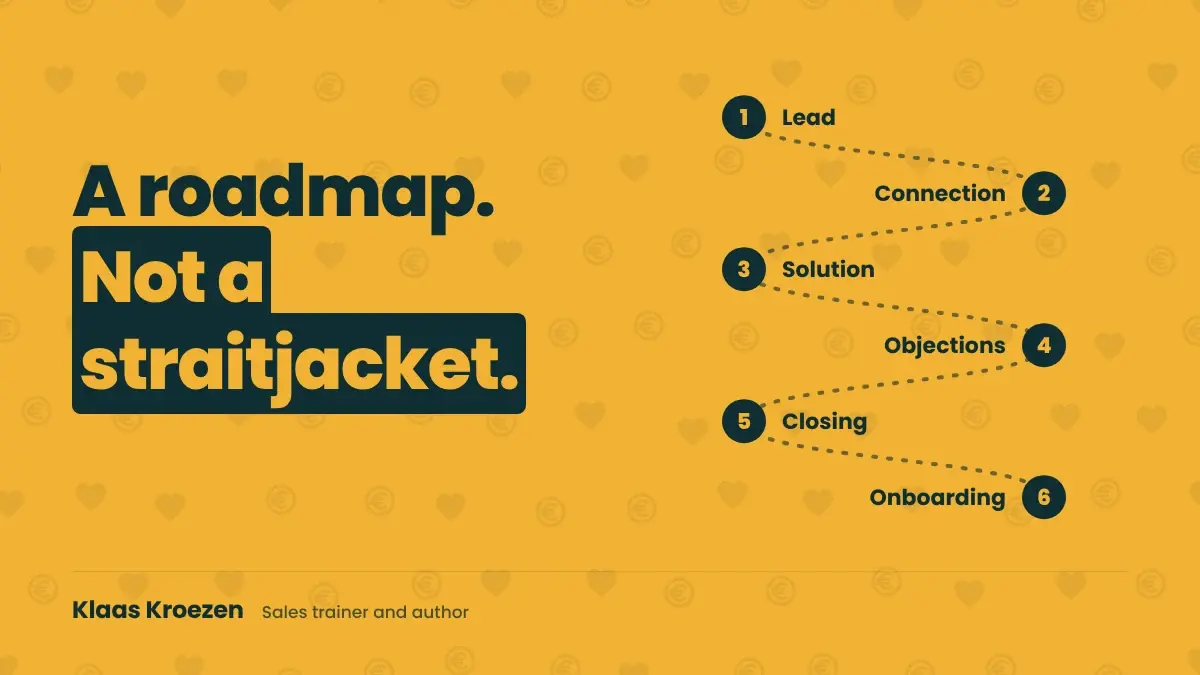
- The six stages of a fan-centric process: lead generation and qualification, connection and discovery, the solution presentation, objections, the close, and onboarding and aftercare.
- Track the number of good appointments every week; that figure already shows today how much revenue is coming in three months from now.
Many people get itchy at the word process. It sounds like a straitjacket, like assembly-line work, like the opposite of personal. I see it exactly the other way around. A good process is your route map. See it as a stage: a solid stage gives the artist the stability and the space to shine. Without a stage it is chaos.
What happens without a sales process?
Because what happens without a process? You forget follow-ups, potential fans fall through the cracks, and your head is overflowing with loose ends. That mental load costs energy, and your customer feels that tension. With a clear process you always know what the next step is. That brings calm, and you radiate that composed, confident energy.
The six phases of a fan-centric sales process
A process that creates fans is designed from the customer's point of view. How do they most like to buy, and how do they want to be helped? The journey has six phases:
- Lead generation and qualification. Find the right people for whom you create the most value, and dare to say a respectful no to a mismatch.
- Connection and discovery. Understanding comes before selling, with open questions and real listening.
- The solution presentation. Link your offer to the problem you have uncovered.
- Objections. Usually these are disguised requests for more information. So, opportunities.
- The close. If you have worked through the process well, this is a shared, logical decision. No pushing needed.
- Onboarding and aftercare. The most important one. Because this is where, after the signature, the fan is born.
Measure what counts in your sales process
Meanwhile, measure what counts. For years, for me that was the number of appointments, because no appointment means no deal. I simply counted them all, every week, with the whole team. That way you can see today how much result is coming in three months' time.
Process is the fifth element of the Customer Experience Model. All the phases, tools and metrics are worked out in Sales, Honest & Relaxed. Start small this week: open your diary and count your good appointments. That is your first metric.
Frequently asked questions
What are the stages of a sales process?
Six: lead generation and qualification, connection and discovery, the solution presentation, objections, the close, and onboarding and aftercare. That last stage is skipped most often, while it is exactly where the fan is born.
Why do you need a sales process?
Without one you forget follow-ups, opportunities fall through the cracks and your head fills with loose ends. Your customer feels that mental load. A clear process creates calm, and you radiate that calm.
What should you steer on in your sales process?
On what you can influence today, for example the number of good appointments per week. No appointment, no deal, and that figure already shows how much is coming in three months from now.
Read also

Klaas Kroezen is an entrepreneur who trains, coaches and speaks. He wrote the #1 Dutch bestseller Sales, Honest & Relaxed and the new book Van klant naar fan (From customer to fan, November 2026). After 25+ years in sales with his own international market research firm, he helps organisations adopt the From customer to fan mindset: selling honestly and relaxed, and turning customers into fans with the whole team.
More about Klaas