Trust and being taken by the hand: what customers value most
For fifteen years we watched hundreds of thousands of customers. Two things always weighed most: trust, and the feeling of being taken by the hand. How to apply it, with Donald Miller's three layers and the customer as the hero.
- In fifteen years of customer research across 21 countries, two things always weighed most: trust, and the feeling of being taken by the hand.
- Every customer problem has three layers: what is practically wrong, how that feels, and the sense that it should not be this way. You make fans on the second and third layers.
- The customer is the hero, you are the guide. A guide talks about the other person's problem instead of their own product.
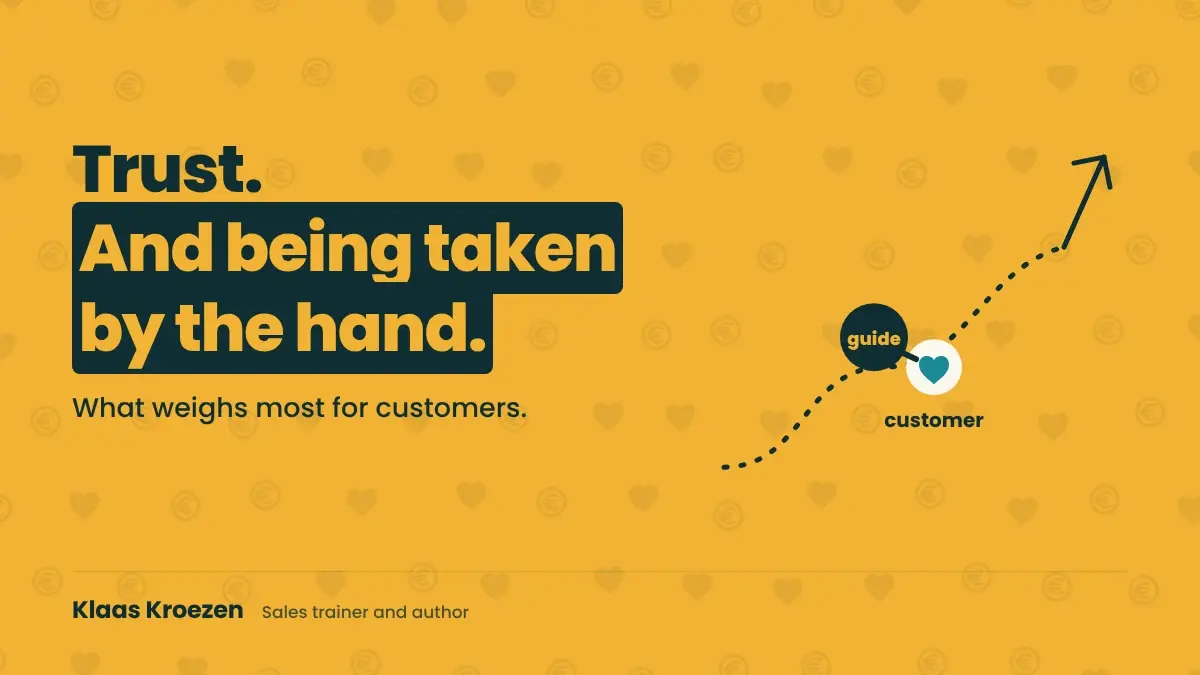
Customers weigh two things most heavily: trust, and the feeling that someone is taking them by the hand. That is not my opinion. It is what we saw for fifteen years across hundreds of thousands of customers.
What we saw in fifteen years of customer research
Our agency WUA started in my student house on the Prinsengracht in Amsterdam. It grew into a customer research agency working in 21 countries, for clients such as Google, Samsung, Microsoft, Bol and ING.
We followed people going through a real customer journey. Looking for a mobile phone with a contract. Submitting a claim to a health insurer. For banks, insurers, telecoms, energy companies, local councils, car dealers and online shops. Afterwards they told us how it felt.
When we calculated what weighed most, two things kept coming out on top.
Trust. Does the customer believe you are honest, that you know what you are talking about and that you put their interests first? Without trust nobody buys. With trust a customer forgives you almost anything.
Being taken by the hand. Does the customer know what is going to happen? Do they feel someone is guiding them, from the first question to long after the purchase? Or do they have to work out the next step themselves?
Of course more plays a part. Your brand, your offer, how everything looks. But these two are where most of the gain is. And they belong to everyone. Every contact, whether it is your website, a phone call or a conversation at the table, makes one of the two bigger or smaller.
How do you build trust with a customer?
Trust is simpler than people think. Yes means yes. No means no. If you say you will call on Friday, you call on Friday.
The odd thing is that trust is often built in an awkward moment. You tell the customer something they did not want to hear. It chafes for a moment. But a customer who has noticed once that you are honest when it does not suit you will believe you from then on when it does.
What does taking a customer by the hand mean?
The customer has no idea how your process works. They do not know what a normal lead time is, when they will hear from you or what is expected of them. They are doing this once. You do it a hundred times a year.
Many people then say: "I do not want to be pushy. The customer should decide for themselves." I understand that reflex. But think about what it means for the customer. They asked you for help, and now you leave them to figure out a process you know inside out.
That is not giving them space. That is leaving them on their own.
Taking someone by the hand means your customer never has to wonder: what now? They know the next step, who to call and when they will hear something. That brings calm. And trust grows in calm.
The three layers of every customer problem
One way of looking at this has helped me enormously. I learned it from Donald Miller, the creator of StoryBrand. He says every customer problem has three layers.
| Layer | Example |
|---|---|
| The practical problem | My screen is too small for my training sessions. |
| How it feels | I feel like an amateur when I present. |
| This should not be this way | Nobody should feel stupid buying a screen. |
Most companies only talk about the top layer. Specifications, resolutions, connections. I experienced that myself with an adviser who spent five minutes on technology without asking me a single question.
You make fans on the second and third layers. Marcel, the account manager I eventually bought from, did not just solve my screen problem. He made sure I felt understood instead of stupid. That is why I still talk about him. You can read that story in the email from France.
Think you know your customer's problem? Ask yourself two questions. What does it do to them? And how should it actually be?
The customer is the hero, you are the guide
Miller adds something that has stayed with me ever since. Every story has a hero and a guide. And in your customer's story, you are not the hero.
The customer is the hero. They have a problem and want to get somewhere. You show them the way. Nobody remembers a guide who talked about how good he was. You are remembered because you helped someone win.
Whoever wants to be the hero talks about their own product. Whoever is the guide talks about the other person's problem.
I love that Miller arrives, through stories, at the same place we reached through research data. He says the customer needs a guide. We found, across hundreds of thousands of people, that feeling taken by the hand is one of the two most important things.
One question you can ask about every customer
In my new Dutch book Van klant naar fan (From customer to fan) I keep coming back to these two. Because it is the simplest lens I know.
Not sure what to do with a customer? Ask yourself: does this increase their trust? And does it make them feel more taken by the hand?
In the Customer Experience Model, that second part belongs to Process: the journey the customer takes with you, as smooth and predictable as possible. Predictable sounds dull. To a customer it is the nicest word there is.
What can you do tomorrow?
Take your last three customer contacts. A conversation, an email, a proposal.
For each one, ask: does the customer now know the next step, and when they will hear from me? If the answer is no, send them one sentence today. "This is what happens now, and you will hear from me on Tuesday." That is all. And see what it does to the next conversation.
Taking someone by the hand means your customer never has to wonder: what now?
Veelgestelde vragen
What do customers value most?
Fifteen years of customer research by WUA, with hundreds of thousands of customers in 21 countries, kept pointing to two factors: trust, and the feeling of being taken by the hand. Those two influence sales and satisfaction more than anything else.
What does taking a customer by the hand mean?
It means the customer always knows what will happen next, who to call and what the next step is, from the first question to long after the purchase. They never have to work out the process on their own.
What are the three layers of a customer problem?
According to Donald Miller of StoryBrand, every problem has a practical layer, a layer of how it feels, and a layer of 'this should not be this way'. Most companies only talk about the first layer.
Why is the customer the hero and not you?
In your customer's story, they have the problem and want to get somewhere. You are the guide who shows the way. You are remembered because you helped someone win, not because you said how good you are.
Lees ook

Klaas Kroezen is ondernemer die traint, coacht en spreekt. Hij schreef de #1 bestseller Sales, Oprecht & Ontspannen en het nieuwe boek Van klant naar fan (november 2026). Na 25+ jaar sales vanuit zijn eigen internationale marktonderzoeksbureau helpt hij organisaties met de mindset Van klant naar fan: oprecht en ontspannen verkopen, en met het hele team van klanten fans maken.
Meer over Klaas