Customer focus: what it really means, and what it does not
Every company calls itself customer focused. But what does customer focus really mean? On attitude, islands between departments and five things you can do tomorrow.
- Customer focus means acting on what the customer really needs, even when that is a little awkward.
- It lives in people and attitude: a fan mindset starts with you, honest and relaxed.
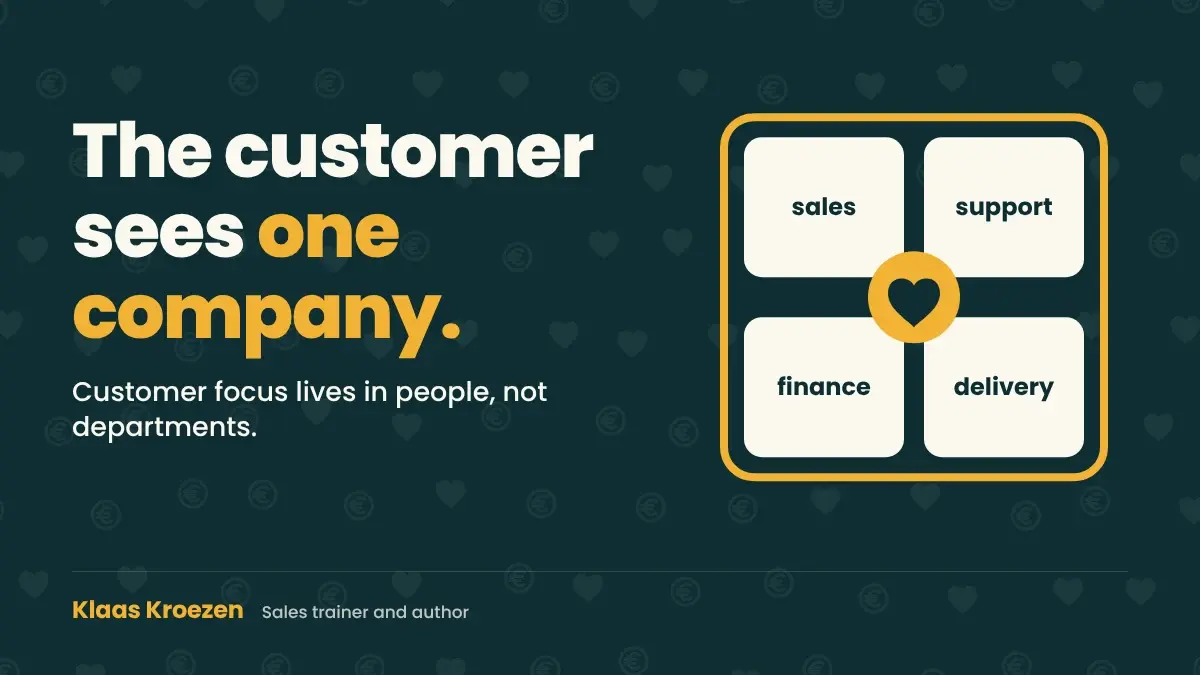
- Your customer does not see departments. He feels every island in your organisation straight away.
I do not know a single company that does not call itself customer focused. It is on websites, in job adverts and on the canteen wall.
Yet as a customer you often notice little of that customer focus. You get transferred. You have to tell your story three times. You get a template email back.
What I have seen over all these years: customer focus is easy to say and hard to do.
What is customer focus?
Customer focus is an attitude in which you act on what the customer really needs, and show it in every contact. From the first conversation until long after the sale, and by everyone in your organisation.
The word really matters here. What a customer asks for and what he needs are not always the same thing.
What customer focus is not
There are two misunderstandings I come across a lot.
Telling customers what they want to hear. Saying yes to everything. Promising what you cannot deliver, because saying no feels uncomfortable. In the short term the customer is happy. Then comes the disappointment, and it is bigger than the honest no would have been.
Giving everything away. An extra hour here, a discount there. With the best of intentions. But a customer does not become a fan of a discount. He becomes a fan of someone who helps him, and who tells him honestly what is and is not a smart move.
Being customer focused sometimes means saying no. Or saying that someone else is a better fit for him. That builds trust. And trust carries a lot of weight. With my research agency I spent fifteen years watching hundreds of thousands of customer journeys. Two things weighed most every time: trust, and the feeling of being taken by the hand.
Customer focus lives in people
You cannot capture customer focus in a procedure. It lives in people. In how you approach a customer.
In my new Dutch book Van klant naar fan (From customer to fan), the first part is called "A fan mindset starts with you". That is where it starts: with how you pick up the phone tomorrow.
I call it honest and relaxed. Honest: you are genuinely interested in the customer and his situation. Relaxed: you do not have to force anything. No pushing, no pleasing. A customer feels that difference immediately.
Max de Weijer discovered this in sales. He went from 1 or 2 customers per 10 leads to 7 or 8. Not by pushing harder, but by being genuinely interested. That attitude works just as well after the sale.
The customer sees one company
This is where many organisations go wrong.
Sales promises something. Delivery knows nothing about it. Support uses yet another system. Finance sends a reminder while a complaint is still open. Every department does its job well, and still the customer feels he is being sent from pillar to post.
One chapter in the book is called "Over the fence". You know the picture: after the signature, a customer is thrown over the fence to the next department. That is how islands appear.
Bain & Company asked 362 companies whether they delivered a superior customer experience. 80 percent said yes. Then they asked their customers. Only 8 percent agreed.
How can that gap be so big? Because every department judges itself on its own piece. Sales knows the conversation went well. Delivery knows it arrived on time. Service knows the complaint was resolved. All three are right. And meanwhile the customer has told his story three times and waited two weeks for an answer.
At Amazon there is an empty chair at the meeting table. It is for the most important person in the room: the customer. It becomes a lot harder to say "that is not my department".
Your customer does not see those departments. He sees one company. He feels every handover that stalls. Everyone helps decide what he experiences: the business owner, the manager, the people who speak to customers and the people who work behind the scenes.
I saw this happen at OCD Opleidingen, a Dutch training company. After an inspiration session, six people were going to do the training: the six who did sales. Then the other five went to owner Micha te Wieske. "We have an influence on this too. We want to take part." In the end the whole organisation followed the programme.
Customer focus in sales and after the sale
Customer focus does not wait until someone is a customer. It starts in the first conversation.
In sales it means: listening before you offer anything. Asking good questions. Saying honestly when your product is not a fit. That way you rarely sell something that later turns into a complaint.
After the sale it means: taking the customer by the hand. Letting him know what is happening and when. Calling him yourself when something is delayed. And seeing a complaint as an opportunity, because a complaint handled well often turns a customer into a fan.
For me, the real work only starts at the signature. That is also what from customer to fan is about.
6 things you can do tomorrow
- Ask one extra question. At the end of every customer conversation, ask: is there anything else I can help you with? And really listen to the answer.
- Say no honestly when you have to. If you cannot deliver something, say so straight away. With an alternative if you have one.
- Check one handover. Pick a customer who has just moved from sales to delivery. Does your colleague know what was promised? If not, sort it out today.
- Put an empty chair in your next meeting. Say at the start that it is for the customer. With every decision, ask: what would they think of this?
- Call one customer for no reason. No sale, no invoice. Just ask how things are going. You will hear things that never show up in a survey.
- Pick up a complaint yourself. Do not pass it on. Call the customer, listen and say what you are going to do. Then do it.
Want to know how customer focused your team really is? Measure it with the free Customer Experience Model scan, or first read why satisfied customers still leave. And if you want to tackle this with your whole team: that is why I created the Customer Success Training.
Which of the six will you do tomorrow?
Your customer does not see departments. He sees one company.
Veelgestelde vragen
What is customer focus?
Customer focus is an attitude in which you act on what the customer really needs, and show it in every contact. It involves the whole organisation, from sales to the colleague behind the scenes.
Does customer focus mean the customer is always right?
No. Being customer focused means being honest, even when the answer is no. Telling customers what they want to hear or giving everything away for free does not help them in the long run.
How does a team become more customer focused?
Start with yourself and your own attitude, then remove the islands between departments. Make sure a customer never notices that he has fallen between two colleagues.
Is customer focus only for customer service?
No. Customer focus starts in the first sales conversation and continues long after the signature. Everyone whose work touches the customer helps decide what he experiences.
Lees ook


Klaas Kroezen is ondernemer die traint, coacht en spreekt. Hij schreef de #1 bestseller Sales, Oprecht & Ontspannen en het nieuwe boek Van klant naar fan (november 2026). Na 25+ jaar sales vanuit zijn eigen internationale marktonderzoeksbureau helpt hij organisaties met de mindset Van klant naar fan: oprecht en ontspannen verkopen, en met het hele team van klanten fans maken.
Meer over Klaas