NPS explained: why an 8 is not a fan yet
What is NPS, how do you calculate it, and why does an 8 not count as a promoter? On the Net Promoter Score, the passively satisfied customer and what to do with your 7s and 8s.
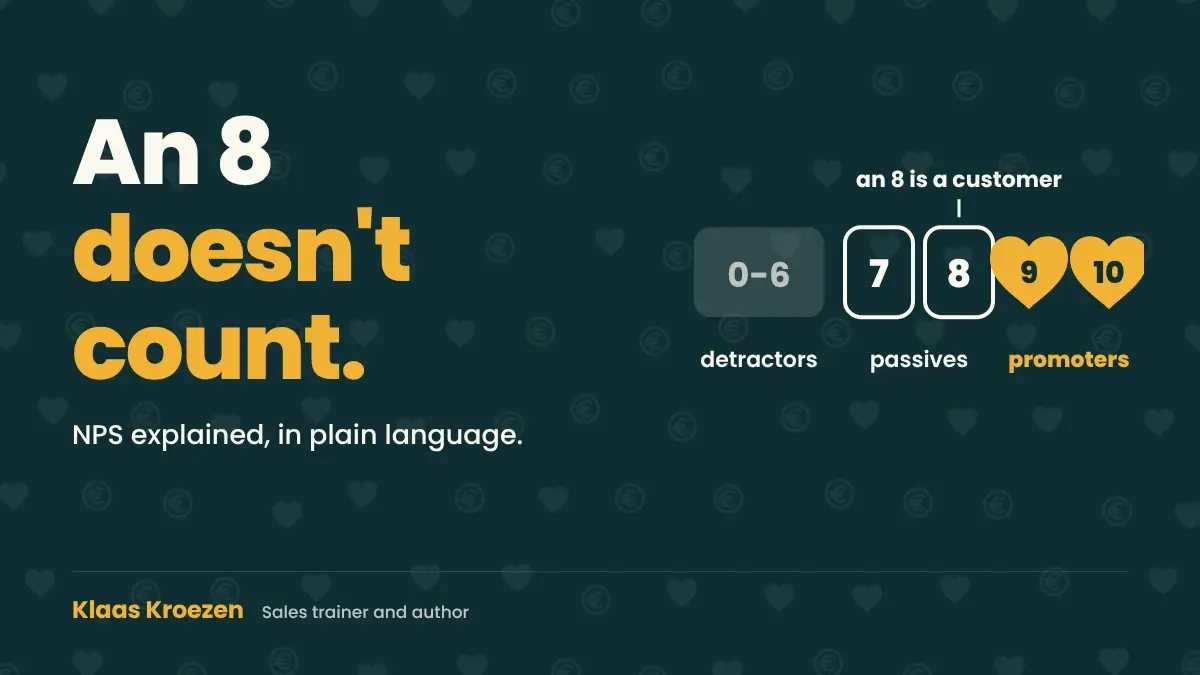
- NPS is the percentage of promoters (9-10) minus the percentage of detractors (0-6). The 7s and 8s do not count.
- An 8 is passively satisfied: a customer, not a fan yet. He will just as easily choose someone else.
- NPS measures a promise. If you want to know whether customers really recommend you, measure behaviour.
A customer gives you an 8. You are pleased. An 8 is a good score, surely?
Not according to the Net Promoter Score. There, an 8 does not count. Not as positive, and not as negative.
That fits exactly with what I write in my new book, the Dutch book Van klant naar fan (From customer to fan): an 8 is a customer. A 9 or 10 is a fan.
NPS (Net Promoter Score) is a measure of customer loyalty. You ask customers how likely they are to recommend you, from 0 to 10, and subtract the percentage of detractors from the percentage of promoters.
Where does NPS come from?
NPS was created by Fred Reichheld of Bain & Company. He published it in Harvard Business Review in 2003, in an article called "The One Number You Need to Grow".
His idea was simple. Instead of long customer satisfaction surveys, you ask one question:
How likely is it that you would recommend us to a friend or colleague?
The customer answers with a number from 0 to 10. That number says something about loyalty. Because someone who recommends you puts his own name on the line.
How do you calculate NPS?
You split the answers into three groups.
| Score | Group | What it means |
|---|---|---|
| 9 or 10 | Promoters | Enthusiastic. Comes back and tells others |
| 7 or 8 | Passives | Passively satisfied. No complaints, but no enthusiasm either |
| 0 to 6 | Detractors | Unhappy. Likely to leave, or to speak negatively about you |
Then you calculate:
NPS = % promoters minus % detractors
You leave the passives out. They do count in the total, but not in the sum.
A worked example
Say you get 100 responses back. This is an example to show the maths, not research.
- 50 customers give a 9 or 10. That is 50% promoters.
- 35 customers give a 7 or 8. That is 35% passives.
- 15 customers give a 6 or lower. That is 15% detractors.
NPS = 50 minus 15 = 35.
The score runs from minus 100 (everyone is a detractor) to plus 100 (everyone is a promoter). It is not a percentage, but a number.
Now look at those 35 passives. More than a third of your customers. They are satisfied. And for NPS they simply do not count.
Why is an 8 not a fan?
Because an 8 says: it was fine. Nothing wrong with it.
But "nothing wrong with it" is no reason to come back. And certainly no reason to tell someone else about you.
For fifteen years I built an international customer research firm, working for brands like Google, Samsung, Microsoft and ING. We watched hundreds of thousands of customers go through a real customer journey. What struck me again and again: a company can do everything properly, and the customer still gives a 7 or an 8.
A customer who gives you an 8 will just as easily choose someone else. A slightly lower price, a friendlier conversation at a competitor, and he is gone. Without a complaint. You only notice once he is no longer there.
A fan does not do that. A fan is happy to come back, buys more and tells others about you. The gap between that 8 and that 9 is the gap between a customer and a fan.
Research has shown this for a long time. Two Harvard researchers, Thomas Jones and Earl Sasser, published an article in 1995 with a title that says it all: "Why Satisfied Customers Defect". In markets where customers can choose, satisfaction is not enough. Loyalty only shoots up at the very top score.
Reichheld saw the same. In his research, scoring twelve points higher on NPS meant on average a doubling of the growth rate. The passively satisfied customer is exactly the customer you risk losing.
What are the limitations of NPS?
NPS is a good start. It is simple and easy to compare over time. Still, it has its limits.
NPS measures a promise. The question is how likely someone is to recommend you. Not whether he actually does. Plenty of customers give a 9 and then tell nobody.
A number does not tell you why. An NPS of 35 does not tell you what to change. For that, you need to talk to customers.
One question says little about your team. The customer sees one company. But NPS does not tell you whether it is down to sales, delivery or the helpdesk.
That is why I built the Fanscore. Your customer scores nine statements, such as "I trust them completely" and "If something goes wrong, I give them the benefit of the doubt". The NPS question is in there, plus one yes/no question: "I have recommended them in the past six months." Someone who says they would recommend you but never has is not a fan yet. So next to the promise, you also measure the behaviour. For more on the different ways to measure, read measuring customer satisfaction.
What do you do with your 7s and 8s?
This is your biggest opportunity. Winning over a detractor is hard. Moving an 8 to a 9 is often much closer than you think.
Here is how to approach it:
- Call them. Not a survey, a conversation. Ask: "You gave us an 8. What would have made it a 9?" Listen. Do not defend yourself.
- Look for the pattern. After ten calls you often hear the same thing. A handover that did not go smoothly. A question that had to be asked three times. An invoice that was wrong.
- Look at the whole team. An 8 rarely comes down to one person. Your customer sees one company. Often the gain lies between departments, where things get thrown over the fence.
- Guide your customer by the hand. In all those years of customer research, two things weighed most: trust, and the feeling of being taken by the hand. Never leave your customer searching for the next step.
- Measure again. Not after a year, but after a few months. That way you see whether it works.
A call like that might go like this. It is an example, not a real customer:
"You gave us an 8 last month. Thank you for that. May I ask what would have made it a 9?"
"Honestly? The work was fine. But I had to call twice before I knew when you were coming."
An answer like that is worth its weight in gold. It is not about your product. It is about how the customer felt. And you can change that tomorrow.
Where do you stand?
Customer focus starts with you, but you create fans together. Want to know how you and your team score on the things that turn a customer into a fan? Use the Customer Experience Model. The scan is free, and with 46 statements you see where you stand. In my new book I explain how to turn satisfied customers into ambassadors.
Your first step can be today: find three customers who gave you an 8 and call them this week.
An 8 is a customer. A 9 or 10 is a fan. And you make that difference.
Veelgestelde vragen
What is NPS?
NPS (Net Promoter Score) is a measure of customer loyalty. You ask customers how likely they are to recommend you, on a scale from 0 to 10. NPS is the percentage of promoters minus the percentage of detractors.
Who invented NPS?
Fred Reichheld of Bain & Company. He published it in Harvard Business Review in 2003, in the article 'The One Number You Need to Grow'.
Why does an 8 not count in NPS?
A 7 or 8 is a passive: satisfied, but not enthusiastic enough to recommend you of his own accord. So he counts neither as a promoter nor as a detractor.
What is a good NPS?
Any score above 0 means you have more promoters than detractors. For comparison: Coolblue scored an NPS of 72 two years running. More important than a single number is whether your score is rising, and whether you know why customers give you an 8 instead of a 9.
What is the difference between NPS and Fanscore?
NPS measures an intention: how likely is it that you would recommend us. The Fanscore includes that question too, but asks nine statements, including whether the customer has actually recommended you in the past six months. That way you also measure behaviour.
Lees ook



Klaas Kroezen is ondernemer die traint, coacht en spreekt. Hij schreef de #1 bestseller Sales, Oprecht & Ontspannen en het nieuwe boek Van klant naar fan (november 2026). Na 25+ jaar sales vanuit zijn eigen internationale marktonderzoeksbureau helpt hij organisaties met de mindset Van klant naar fan: oprecht en ontspannen verkopen, en met het hele team van klanten fans maken.
Meer over Klaas