Why satisfied customers leave: what Xerox discovered
An 8 feels good, but satisfied customers disappear without a word. Xerox found it in the early nineties: only the 9s and 10s truly stay. What that means for your customer satisfaction and retention.
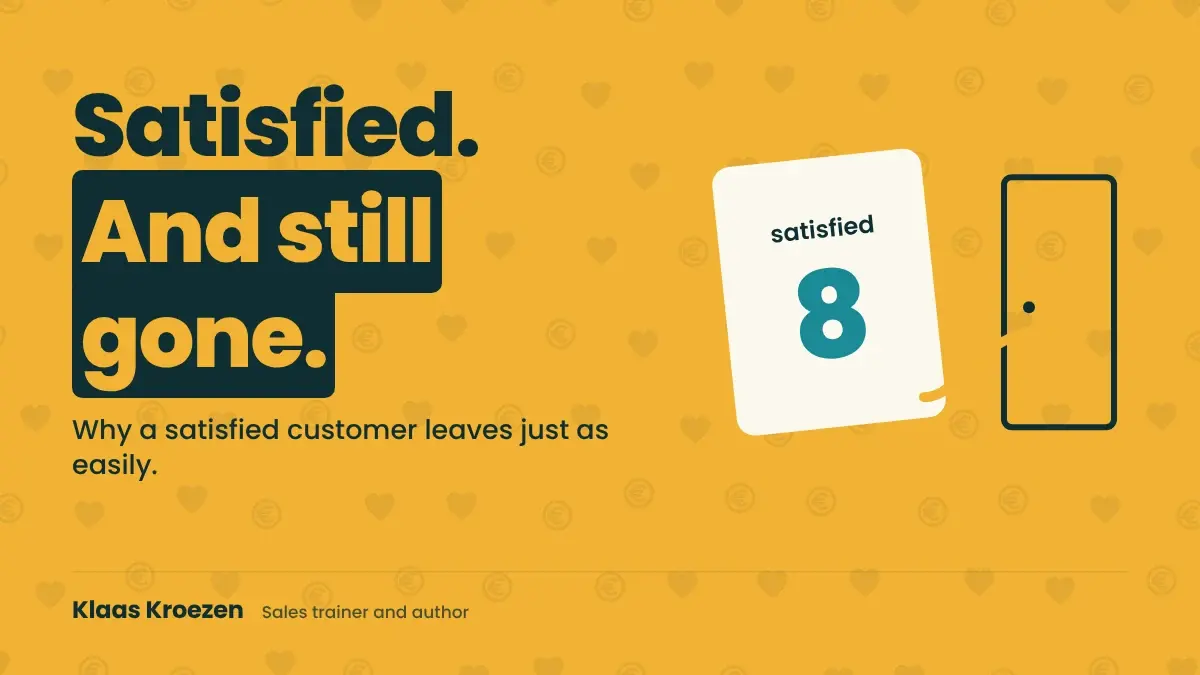
- A satisfied customer (a 7 or 8) does not complain, but forgets you and quietly leaves as soon as something else comes along.
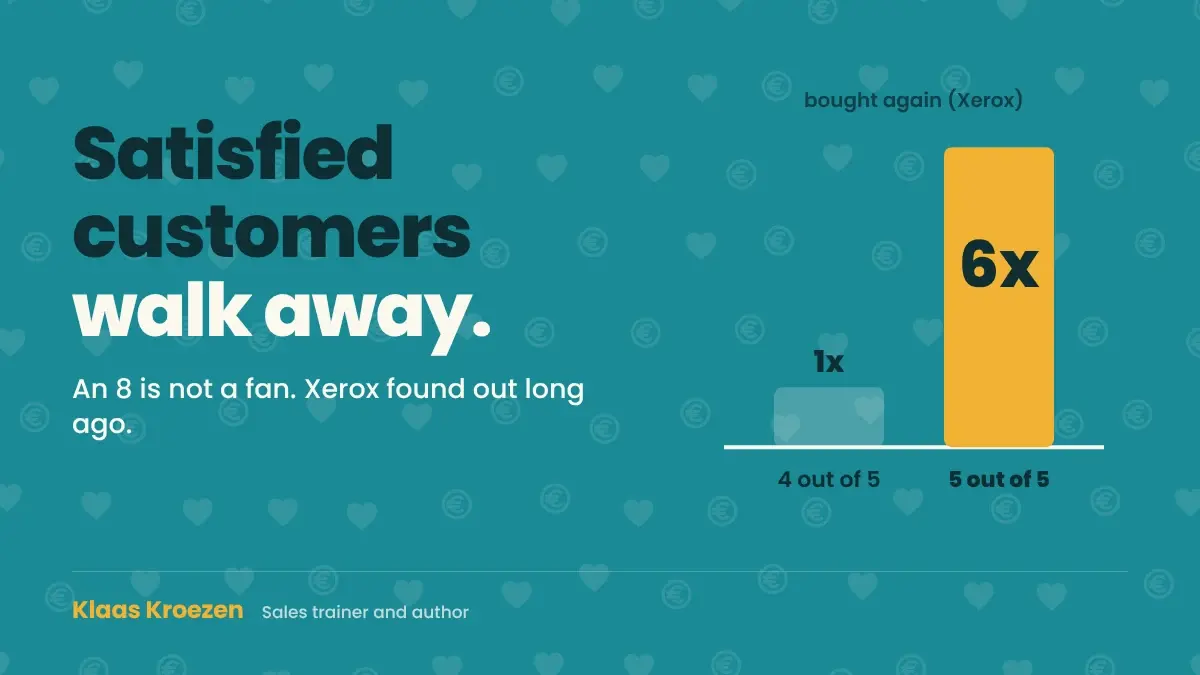
- Xerox found that customers who scored 5 out of 5 bought again six times as often as those who scored 4. Loyalty lives right at the top.
- Fans stay longer, buy more, cost less and bring new customers. Advertising you buy. Fans you earn.
Satisfied customers leave because there is nothing to remember. A customer who gives you a 7 or 8 got exactly what they expected. Next time they simply search again, and buy somewhere else without a word of complaint.
I remember clearly when I first felt this myself.
Everything was running, and still something was off
I was walking through the office of my own company. The numbers were fine. Customers were satisfied. Nobody complained.
And yet the energy was low. People were doing their thing. Answering emails, clearing tasks, getting through meetings. Everything ran, but it felt as if we were slowly burning out.
Our company had grown because customers recommended us. Because they stayed and grew with us. That was the only way we could grow. And I was looking at an organisation where an 8 had become good enough.
I have had that feeling more often since. In my own companies, and in companies I walked into as CEO of our customer research agency or as an adviser. The dangerous part is that you only see it when it is too late.
Because satisfied customers do not complain. They simply disappear.
What does a customer who gives you an 8 actually do?
They forget you.
Not out of ill will. They have what they needed and get on with their day. Next time they need something, they start from scratch. They compare prices. They ask a colleague. They look on Google or ask AI. If you are not at the top, they buy elsewhere. No grudge. You never hear about it.
Ask in an exit conversation why someone is leaving and you usually hear: "You were too expensive." That sounds reasonable. But in fifteen years of customer research I saw something else, time and again. Customers rarely leave because of one mistake. They leave because nothing happened. No attention, no surprise, no reason to stay.
Too expensive is the excuse. No attention is the reason.
What did Xerox discover?
In the early nineties Xerox did something that was unusual at the time. They asked their customers, on a large scale, how satisfied they were on a scale of 1 to 5. Then they looked at what those customers did over the next eighteen months. Did they buy again?
The result turned thinking about customer satisfaction on its head. Customers who gave a 5 bought again six times as often as customers who gave a 4.
Six times. That is not a small difference.
A 4 out of 5 is an 8 out of 10. Those are your satisfied customers. And they behaved almost the same as customers who were only moderately satisfied. The difference was right at the top.
Two Harvard researchers, Thomas Jones and Earl Sasser, set out to see whether the same held in other markets. Cars, computers, hospitals, airlines. In 1995 they published their conclusion in Harvard Business Review, under a title that says it all: "Why Satisfied Customers Defect".
Their finding: in markets where customers can choose, satisfaction is not enough. The line between satisfaction and loyalty stays flat for a long time. It only shoots up at the very highest score.
They called the customers at the top apostles. I call them fans.
What is a fan worth to you?
This is the question every business owner asks. The answer: more than you think.
| Research | What they found |
|---|---|
| Reichheld (Bain & Company) and Sasser, 1990 | Five per cent less customer loss produced 25 to 85 per cent more profit in the industries studied |
| Reichheld, NPS | Twelve points higher on the recommendation question meant, on average, a doubling of the growth rate |
| Harvard Business Review | Winning a new customer is 5 to 25 times more expensive than keeping an existing one |
| Nielsen | 92 per cent trust recommendations from friends and family |
| Wharton | Customers who come in through a recommendation leave 18 per cent less often |
Look at that first line. It is about profit, not turnover. A customer who stays becomes cheaper to serve, buys more over time and cares less about price.
Add it up. Fans stay longer, buy more, cost less and bring new customers with them. I know few investments that do all of that at once. Or, as I put it in my new Dutch book Van klant naar fan (From customer to fan), out on 14 November: "Advertising you buy. Fans you earn."
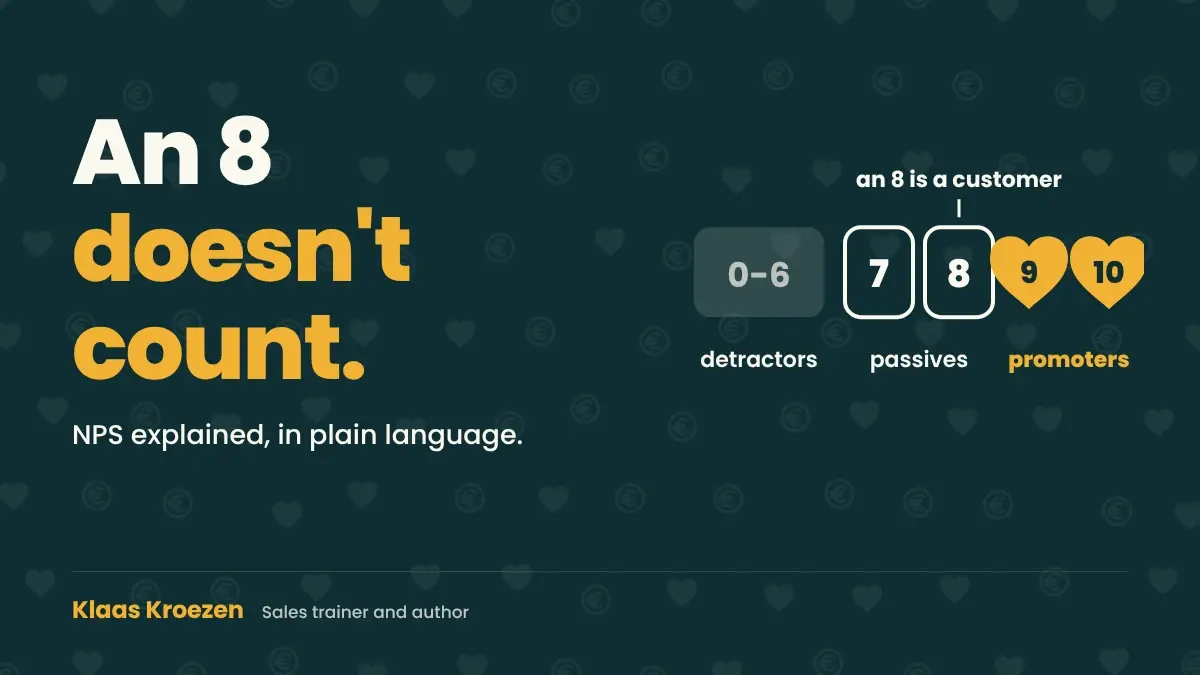
This is also exactly why the Net Promoter Score does not count a 7 or an 8 as a promoter. I wrote about that in NPS: why an 8 is not a fan.
The question almost nobody asks
Most companies ask themselves how to get more customers. There is a better question, and I rarely hear it.
Why would anyone want to be a fan of ours?
Try answering it out loud. If your answer is "because we deliver good quality", you have an 8. Your competitor does that too.
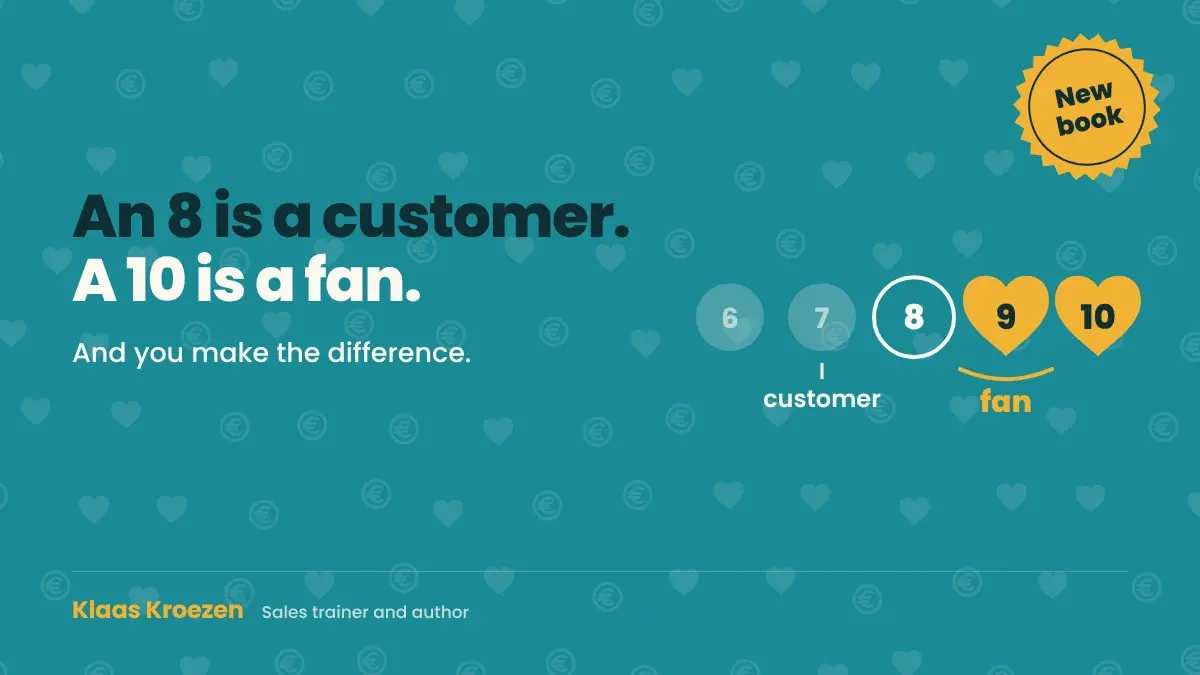
At a 6, 7 or 8 you are doing your job. At a 9 or 10 you make the difference. And that difference is rarely in your product. It is in the attention. In the extra question you asked. In the call you made before the customer had to chase you.
What can you do tomorrow?
Take a sheet of paper. Write down your ten to twenty most important customers.
- Give each customer a score. Not the score you would give yourself, but the score the customer would give you if I rang them tomorrow. Be honest. A 7 is a 7.
- Look at your 9s and 10s. What did you do differently with them? You usually know straight away. More attention. More questions. A quick call back. Write it down, because you can do that with every customer.
- Pick one 7 or 8. These are the customers you can lose without noticing. Call them this week. Not to sell anything. Ask how things are going and what could be better.
Run an online shop, or serve thousands of customers you never speak to? Take your last twenty reviews and sort them into three piles: enthusiastic, satisfied, disappointed. Then call three people from the middle pile. They are not unhappy, and that is exactly why they can tell you what is missing.
Who is your quiet 8, and when will you call them?
Satisfied customers do not complain. They simply disappear.
Veelgestelde vragen
Why do satisfied customers leave?
Because there is nothing to remember. A customer who gives you a 7 or 8 got what they expected. Next time they start searching and comparing again, and buy elsewhere without complaint.
What did Xerox discover about customer satisfaction?
In the early nineties Xerox saw that customers who scored 5 out of 5 bought again six times as often in the following eighteen months as those who scored 4. A 4 out of 5 is an 8 out of 10: satisfied, but not loyal.
What is the study Why Satisfied Customers Defect?
Thomas Jones and Earl Sasser of Harvard published it in Harvard Business Review in 1995. They showed that in markets where customers can choose, satisfaction is not enough: loyalty only shoots up at the very highest score.
What is a fan worth?
According to Reichheld and Sasser (1990), five per cent less customer loss produced 25 to 85 per cent more profit in the industries studied. Fans stay longer, buy more and are less sensitive to price.
Lees ook

Klaas Kroezen is ondernemer die traint, coacht en spreekt. Hij schreef de #1 bestseller Sales, Oprecht & Ontspannen en het nieuwe boek Van klant naar fan (november 2026). Na 25+ jaar sales vanuit zijn eigen internationale marktonderzoeksbureau helpt hij organisaties met de mindset Van klant naar fan: oprecht en ontspannen verkopen, en met het hele team van klanten fans maken.
Meer over Klaas