"Too expensive": handling the price objection without giving a discount
The "too expensive" objection is rarely a no. The LEVER method from my book helps you find the real objection and put value centre stage, without a discount.
- The too expensive objection is rarely a no, usually a disguised request for more information.
- The LEVER method (Listen, Empathise, Verify, Respond) from my book Sales, Honest & Relaxed helps you find the real objection instead of giving a discount.
- Anyone who makes the value clear makes the price secondary.
There it is again: "Interesting, but the price is rather high." For many salespeople this is the moment the discount comes onto the table. A shame. You give away margin, and you also confirm that your price was not right in the first place.
A price objection is not a no
First this: an objection is not a no. It is almost always a disguised request for more information, an expression of uncertainty, or a signal that the customer does not yet see the full value. See it as a chance to dig deeper and build trust.
I saw this in fifteen years of customer research too. Ask departing customers why they are leaving and most will say: "You were too expensive." It sounds logical and it hurts nobody. But look a little deeper and most of them left because they felt nobody cared about them. Too expensive is often the excuse. No attention is the reason.
The LEVER method for the price objection
In my book Sales, Honest & Relaxed I describe the LEVER method for this. Four letters, four steps:
- Listen. Let the customer finish completely, without interrupting or immediately going on the defensive.
- Empathise. Show you understand how they feel. "I understand that the investment is an important consideration." That is not giving in, it is letting them know you hear them.
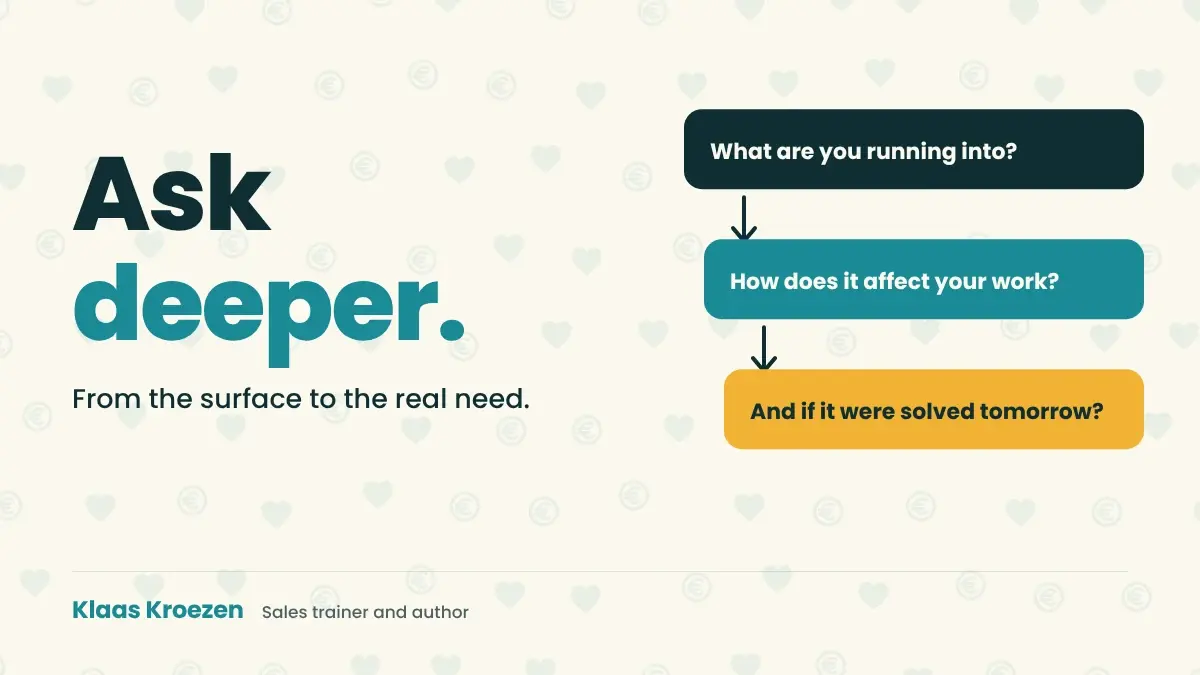
- Verify. This is the step almost everyone skips. Ask: "What specifically about the investment worries you?" Often "too expensive" turns out to mean something else. No budget this quarter. Doubt whether the result will actually come. A colleague who needs convincing. Each of those real objections calls for a different answer than a discount.
- Respond. Only when you know the real objection do you respond in a targeted way, linked to the customer's problem and goal. Do not promise more than you can deliver.
Marcel, the account manager from the opening of that book, showed how this works. He suggested an option that was more expensive than what I was looking for. He explained exactly why it suited my needs better. I bought the more expensive screen, and I still use it every day.
Do you believe in your price yourself?
And check yourself: do you actually believe in your price? If deep down you carry the belief "my service is too expensive", you radiate that and every price conversation becomes a struggle. Turn that belief around: my service delivers value that amply justifies the investment.
Quantify that value too. How much time does the customer save, what revenue growth or peace of mind does it deliver? A high price is not a problem, as long as the experience lives up to it. Anyone who makes the value clear makes the price secondary.
Objections are part of the process and touch on your beliefs, two elements of the Customer Experience Model. Why giving a discount costs you more than you think, you can read in this article. Before your next price conversation, write down your clarifying question so you have it ready: "What specifically about the investment worries you?"
Anyone who makes the value clear makes the price secondary.
Veelgestelde vragen
How do I handle the too expensive objection?
See it not as a no, but as a disguised request for more information. Listen fully first, acknowledge the customer's feeling and clarify what is really behind it. Too expensive often means something else, such as no budget this quarter or doubt whether the result will come. Only once you know the real objection do you respond in a targeted way.
Should I give a discount when I hear a price objection?
Preferably not. A discount gives away margin and confirms that your price was not right in the first place. Instead, make the value concrete: how much time, revenue or peace of mind does it deliver the customer? Anyone who makes the value clear makes the price secondary.
What is the LEVER method?
LEVER is the method for objections from my book Sales, Honest & Relaxed. Listen: let the customer finish. Empathise: show you understand how they feel. Verify: ask what is really behind it. Respond: only then give a targeted answer. You practise it with your own cases in the Sales Excellence Training.
Do customers really leave because you are too expensive?
Rarely. In fifteen years of customer research I saw that departing customers often say you were too expensive, while the real reason is usually that they felt nobody cared about them. Too expensive is the excuse. No attention is the reason.
Lees ook

Klaas Kroezen is ondernemer die traint, coacht en spreekt. Hij schreef de #1 bestseller Sales, Oprecht & Ontspannen en het nieuwe boek Van klant naar fan (november 2026). Na 25+ jaar sales vanuit zijn eigen internationale marktonderzoeksbureau helpt hij organisaties met de mindset Van klant naar fan: oprecht en ontspannen verkopen, en met het hele team van klanten fans maken.
Meer over Klaas